
There is no item in your cart
Request a Free Quote
Table of Contents
ToggleTable of Content
Start Your Cosmetic Brand Today!
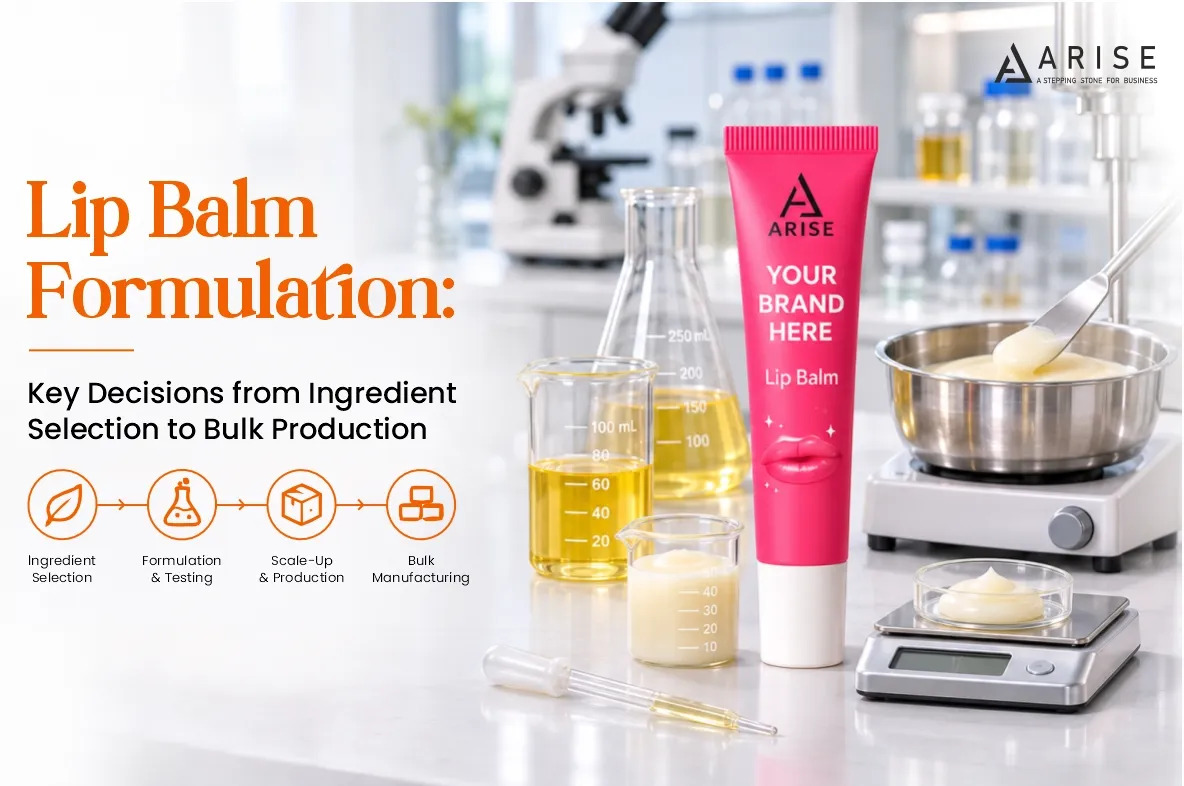
Introduction
Lip balm formulation decides whether a balm that feels perfect in the lab still performs once it reaches customers. A stick may become too firm in winter, soften during summer deliveries or develop a grainy texture after storage.
For cosmetic brands, understanding these formulation decisions before approving a sample helps them select suitable ingredients, choose packaging and prepare a product for India’s changing seasons and bulk production.
Quick Summary
Lip balm formulation balances waxes for structure, oils for glide and butters for body, then matches that blend to the pack format and India’s temperature swings. Approve the formula only after heat, cycling and pack tests, and back every SPF, tinted or vegan claim with evidence before bulk production.
What Is Lip Balm Formulation?
Lip balm formulation is the process of selecting and combining cosmetic ingredients to create a product that protects, softens and moisturises the lips. The right ingredient balance determines its consistency, feel, stability and appearance.
Most conventional lip balms use an anhydrous formulation, meaning they contain little or no added water. Waxes provide structure, oils improve spreadability, and butters or other emollients create a soft, comfortable feel. Together, they form a protective layer that helps reduce moisture loss.
What Are the Key Lip Balm Ingredients and What Does Each Do?
A conventional lip balm ingredients list has three main groups: waxes for structure, oils and butters for texture and conditioning, and supporting additives for stability, flavour and colour.
Which Waxes Provide Structure and Stability to Lip Balm?
Waxes give the balm its shape and help retain oils within the formula. Common options include:
| Wax | Approximate Melting Range | Role in Lip Balm |
|---|---|---|
| Beeswax | 61–65°C | Provides flexible structure and smooth application |
| Candelilla wax | 68–73°C | Adds firmness to vegan formulations |
| Carnauba wax | 80–86°C | Increases structural strength and heat resistance |
| Rice bran wax | 79–85°C | Helps adjust hardness and oil retention |
Formulators often combine waxes to balance firmness and glide. A high-melting wax does not automatically make the finished balm resistant to summer heat. The oil blend, proportions, and cooling process matter too. Melting ranges vary by material grade.
How Do Oils and Butters Affect Lip Balm Texture and Moisturisation?
Oils influence spreadability, while butters add body and affect the balm’s feel. Examples include:
- Castor oil: Adds shine and viscosity while supporting smooth application.
- Coconut oil: Improves glide but changes consistency with temperature.
- Jojoba oil: Gives a lighter feel and has relatively good oxidative stability.
- Shea butter: Adds richness but can become grainy under unsuitable cooling conditions.
- Cocoa butter: Provides firmness and a creamy texture; its crystallisation needs control.
Waxes and occlusive ingredients, such as petrolatum, can also form a protective layer that helps reduce moisture loss. A richer feel alone does not guarantee better moisture retention.
What Roles Do Antioxidants, Flavours, Colours and Other Additives Play?
- Antioxidants: Tocopherol (vitamin E) can slow oil oxidation and the development of rancid odours, but does not control microbial contamination.
- Flavours and fragrances: Must be suitable for lip use. Some mint and cinnamon compounds may irritate sensitive users.
- Colours: Require even dispersion to avoid grittiness or inconsistent shades.
Because lip products may be ingested incidentally during normal use, ingredient suitability and applicable restrictions matter when selecting additives.
Formulators often combine waxes to balance firmness and glide. A high-melting wax does not automatically make the finished balm resistant to summer heat. The oil blend, proportions, and cooling process matter too. Melting ranges vary by material grade.
How Do Oils and Butters Affect Lip Balm Texture and Moisturisation?
Oils influence spreadability, while butters add body and affect the balm’s feel. Examples include:
- Castor oil: Adds shine and viscosity while supporting smooth application.
- Coconut oil: Improves glide but changes consistency with temperature.
- Jojoba oil: Gives a lighter feel and has relatively good oxidative stability.
- Shea butter: Adds richness but can become grainy under unsuitable cooling conditions.
- Cocoa butter: Provides firmness and a creamy texture; its crystallisation needs control.
Waxes and occlusive ingredients, such as petrolatum, can also form a protective layer that helps reduce moisture loss. A richer feel alone does not guarantee better moisture retention.
What Roles Do Antioxidants, Flavours, Colours and Other Additives Play?
Supporting ingredients affect shelf stability, appearance and the application experience.
- Antioxidants: Tocopherol (vitamin E) can slow oil oxidation and the development of rancid odours, but does not control microbial contamination.
- Flavours and fragrances: Must be suitable for lip use. Some mint and cinnamon compounds may irritate sensitive users.
- Colours: Require even dispersion to avoid grittiness or inconsistent shades.
Because lip products may be ingested incidentally during normal use, ingredient suitability and applicable restrictions matter when selecting additives.
How Do Ingredient Ratios Affect Lip Balm Consistency and Performance?
Changing the balance of waxes, oils and butters can improve one property while creating another problem.
| Formulation Change | Possible Benefit | Potential Drawback |
|---|---|---|
| More wax | Greater firmness | Drag, brittleness or excessive hardness |
| More liquid oil | Softer texture and better glide | Sweating or reduced heat resistance |
| More solid butter | Richer feel and more body | Graininess or unwanted crystals |
| Different wax blend | More control over structure | Changes in compatibility or texture |
Ingredient type matters as much as ingredient percentage. Replacing one wax with another at the same concentration can produce a different result. Formulators therefore assess the complete blend rather than following a fixed wax-to-oil ratio.
Build your lip balm with the right balance of waxes, oils and butters for your brand.
How Does Packaging Selection Affect a Lip Balm Formula?
Packaging should be selected early because each format needs a different consistency:
- Twist-up sticks: Need enough strength to hold their shape during application.
- Squeeze tubes: Must dispense smoothly without excessive leakage.
- Jars or pots: Can hold softer balms but need consideration of handling and contamination.
During storage, oils, flavours or fragrances may interact with some packaging materials. A formula developed for a jar may require changes before it can work reliably in a stick, so compatibility should be assessed in the intended pack.
Which Lip Balm Variants Can Brands Develop?
Brands can develop natural, vegan, flavoured, tinted and SPF lip balms. Some share a similar base, but others require different ingredients, processing controls or claim-specific testing.
What Changes When Formulating Natural or Vegan Lip Balms?
Vegan lip balms replace animal-derived materials such as beeswax and lanolin with alternatives including candelilla, carnauba and rice bran wax. These waxes differ in hardness and crystallisation, so substitutions usually require changes to the oil blend and proportions.
Natural lip balm ingredients also need attention to raw-material variation. Plant oils and butters can differ between suppliers or batches, affecting appearance and oxidation stability. Brands should check ingredient origins and supplier documentation before making natural or vegan claims.
How Is Tinted Lip Balm Different from Regular Lip Balm?
Tinted lip balms must provide even colour without compromising glide. Formulators may pre-disperse pigments in an oil such as castor oil, using further milling where needed to avoid grittiness.
Before approval, brands should assess shade consistency, colour stability under heat and light, and whether the added pigments change the balm’s feel. Colourants must be permitted for lip application.
What Does Adding SPF to a Lip Balm Require?
An SPF lip balm requires permitted UV filters at suitable concentrations, with reliable dissolution or dispersion in the wax-and-oil base. Mineral filters such as zinc oxide can affect appearance, while some organic filters introduce solubility and stability challenges.
SPF cannot be determined from filter concentration alone. The finished balm needs in vivo SPF testing under IS 17494:2025, which applies from 10 January 2026, and any UVA or broad-spectrum claim needs separate evidence. UV filters must appear in IS 4707 (Part 4):2022 and stay within its limits. The standards that apply are listed in the compliance section below.
How Should Brands Formulate a Lip Balm for Indian Winters and Summers?
A year-round lip balm must remain comfortable in colder conditions without losing its shape during summer storage and transport. Brands may instead develop separate seasonal variants, depending on their target market and distribution conditions.
How Do You Make a Lip Balm Winter-Ready?
Lower temperatures can make a stick firmer, causing drag or brittleness during application. Repeated warming and cooling may also alter wax or butter crystals, creating graininess or a pale surface bloom.
Formulators can improve winter application by adjusting the balance of hard and flexible waxes, refining the oil-and-butter blend and selecting suitable occlusive ingredients to help reduce moisture loss.
The aim is smooth application at lower temperatures without making the balm unstable when it encounters warmer conditions. Lip balm is one of several categories in our guide to winter skincare product ideas for cosmetic brands.
How Do You Stop Lip Balm Melting, Sweating or Blooming in Summer?
Summer storage and delivery can expose balms to high temperatures. Different defects call for different adjustments:
- Melting or deformation: The wax structure softens. A revised wax blend, sometimes using a small amount of higher-melting wax, may improve shape retention.
- Sweating: Oil droplets appear on the surface. Better oil-wax compatibility and suitable oil-binding materials may help.
- Blooming: A whitish surface develops after changes in crystallisation. Ingredient balance and controlled cooling can reduce the risk.
Before approving the formula, brands should use stability testing to assess expected warehouse and transportation conditions, especially for peak summer distribution.
What Is the Lip Balm Formulation Process?
Cosmetic product development turns a brand’s product requirements into an approved reference sample and documented specifications for testing and manufacturing.
Before laboratory work begins, the brand and manufacturer should agree on:
- Format and pack size: Stick, tube or jar.
- Target experience: Intended users, glide, hardness, finish, flavour and colour.
- Ingredients and claims: Vegan, natural-positioned, tinted, SPF or other requirements.
- Commercial needs: Target cost, expected volume and distribution conditions.
Formulators then define measurable product specifications, such as appearance, hardness, melting behaviour and fill weight.
With custom formulation, brands review samples and provide feedback before the reference formula is approved.
If a balm feels waxy, formulators may revise the wax blend; if it feels greasy, they may adjust the oil balance. The approved reference sample then moves to stability evaluation and manufacturing development.
How Is Lip Balm Tested for Stability, Quality and Compliance?
The testing plan depends on the formula, packaging, intended shelf life and claims.
How Are Heat Stability, Shelf Life and Safety Tested?
Manufacturers may use the following assessments:
- Hardness and stick strength: Penetration or breakage tests assess firmness and resistance to damage.
- Melting range or drop point: Defined methods evaluate thermal behaviour; these measurements are not interchangeable.
- Heat stability: High-temperature storage checks whether the balm retains its intended appearance and structure.
- Temperature cycling: Alternating warm and cold conditions helps reveal changes that may not appear during constant-temperature storage.
Shelf-life studies track odour, colour, texture and oil oxidation over time.
Packaging assessments check leakage, material interactions and dispensing, including whether twist-up mechanisms continue working. Safety assessments consider ingredient restrictions, relevant contaminants and microbial testing requirements.
Conventional anhydrous balms carry a lower microbial-growth risk than water-based products, and hot filling adds a further safeguard. ISO 29621:2017 treats a filling temperature above 65°C, or a water activity of 0.75 or below, as low-risk factors. It does not grant an automatic exemption. The manufacturer must document the risk assessment for the finished formula, filling process and pack, and decide which microbiological tests still apply.
Which Indian Standards and Labelling Rules Apply to Lip Balm?
Indian cosmetics are regulated under the Drugs and Cosmetics Act, 1940, the Cosmetics Rules, 2020, and applicable BIS specifications. Relevant standards include:
- IS 10284:2026: Lipsalve specification (first revision), covering petroleum- or vegetable-oil-based lip balms.
- IS 4707 (Part 1):2020: Permitted cosmetic colourants.
- IS 4707 (Part 2):2025: Generally not recognised as safe and restricted ingredients.
- IS 4707 (Part 4):2022: Permitted UV filters and use restrictions.
- IS 17494:2025: In vivo SPF test method (ISO 24444:2019, modified), applicable from 10 January 2026.
- IS 17493:2021: In vitro UVA protection test method, for UVA or broad-spectrum claims.
- IS 19685:2026: Sunscreen cosmetics specification; check whether your SPF lip balm falls within its scope.
Product classification matters: a tinted balm may also need assessment against IS 9875:2018, the lipstick specification.
Rule 34 sets cosmetic labelling requirements, including the product name, applicable manufacturer and licence information, batch details, expiry or use-before information and ingredients. Ingredients above 1% are generally listed in descending order, followed by those at or below 1% in any order. The ingredient list need not appear on packs of 30 g or less of solids or semi-solids, which covers most lip balms. Packs of 10 g or less are also exempt from the batch number, though the other mandatory label details still apply.
Rule 36 prohibits false or misleading cosmetic claims; claims such as SPF 30 must be supported before artwork is approved.
Take your lip balm from approved formulation to bulk production with Arise Cosmetic.
How Is a Lip Balm Formula Scaled Up for Bulk Production?
A lip balm formula that works in a laboratory may not perform the same way in a larger production batch. Larger equipment changes how ingredients heat, mix and cool, which can affect the finished balm’s texture, appearance and consistency.
What Happens During the Bulk Manufacturing Process?
Conventional hot-poured lip balms usually follow six stages:
- Prepare: Check and weigh approved raw materials.
- Melt: Heat waxes, oils and butters to form a uniform mixture.
- Mix: Blend thoroughly, adding pigments and temperature-sensitive ingredients at appropriate stages.
- Fill: Transfer the molten balm to containers or moulds at controlled temperatures.
- Cool: Allow the product to set under defined conditions.
- Inspect and pack: Check the finished units against specifications before packing.
What Can Go Wrong Between Pilot and Full-Scale Batches?
Common issues include:
- Loss of flavour: Prolonged heating can reduce the intensity of volatile flavour ingredients.
- Uneven shade: Pigments may settle or disperse poorly in tinted products.
- Air pockets and sinkholes: Trapped air or contraction during setting may leave visible gaps.
- Fill-weight variation: Viscosity and filling conditions can change the dispensed amount.
- Inconsistent setting: Different cooling rates can produce variation between units.
Before manufacturing, raw materials are verified against approved specifications and relevant supplier certificates of analysis. During production, manufacturers monitor critical factors such as heating temperatures, mixing conditions, filling and cooling.
When evaluating a manufacturing partner, brands should check how these production controls and batch records are maintained to support traceability and investigate variations. Good Manufacturing Practices (GMP), supported by guidelines such as ISO 22716:2007, help maintain consistent quality across production batches.
How Does Arise Cosmetic Handle Custom Lip Balm Formulation and Bulk Production?
At Arise Cosmetic, we develop custom lip balm formulations around your brand’s requirements, rather than offering ready-made white-label formulas. Lip balm is part of our private label skin care manufacturing range.
Since 2017, we’ve supported cosmetic brands with custom formulation and manufacturing. We operate two dedicated manufacturing units in Gandhinagar, Gujarat, with 21,000+ sq ft of combined production space, and our facilities are GMP-certified, ISO 22716:2007-certified and FDA-approved. From laboratory samples to bulk production, we focus on formulation consistency, quality requirements and manufacturing feasibility. Every project is covered by an NDA to protect formula confidentiality. If you are still comparing partners, our list of the top lip balm manufacturers in India compares the main options.
Have a lip balm concept but aren’t sure which formulation will work best? Talk to our formulation team about the texture, ingredients and packaging you have in mind.
About the Author

Arise Cosmetic
Arise Cosmetic is a GMP-certified, ISO-compliant, FDCA-approved private label cosmetic manufacturer based in Gandhinagar, Gujarat. Founded in 2017, the team has developed 2,000+ formulations across hair care, skin care, baby care, men's grooming, and intimate hygiene. Arise Cosmetic works with D2C brand founders, salon owners, direct selling companies, and first-time beauty entrepreneurs across Globally, guiding them from formulation brief to bulk delivery under one roof.