
There is no item in your cart
Request a Free Quote
Table of Contents
ToggleTable of Content
Start Your Cosmetic Brand Today!
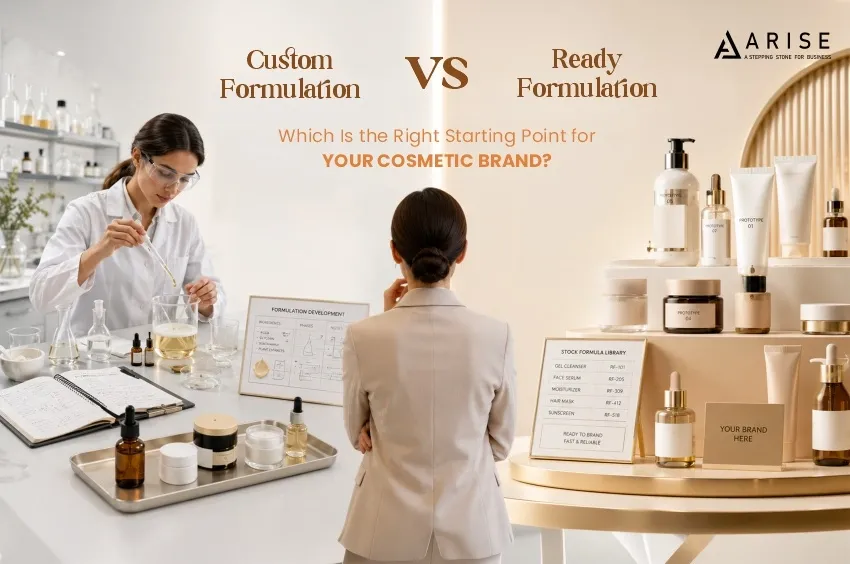
Introduction
Every cosmetic brand starts with the same question: what goes inside the bottle?
Before you think about packaging, pricing, or marketing – you need to decide how your product is going to be made. And in India’s private label cosmetic manufacturing space, that decision comes down to two paths: custom formulation or ready formulation.
Both are legitimate routes. Both can get you to market. But they serve very different business goals, timelines, and budgets. Choosing the wrong one early doesn’t just cost you money – it can delay your launch by months or box you into a positioning you didn’t intend.
This post breaks down exactly what each option means, what it costs, and how to figure out which one is the right starting point for your brand.
Ready formulations are pre-developed, tested, and available for quick launch with low MOQs. Custom formulations are built from scratch to your brief, giving you ingredient control, unique claims, and formula exclusivity. The right choice depends on your budget, timeline, differentiation strategy, and how much validated demand you already have.
Key-Takeaways
Ready formulations are faster and cheaper to launch – ideal for founders testing a market or working with a limited initial budget.
Custom formulations give you ingredient control, unique performance claims, and formula exclusivity – but they require more time and upfront investment.
- You do not own the formula with a ready formulation; it stays with the manufacturer and can be used by other brands.
- Custom formulation in India typically costs between Rs. 50,000 and Rs. 5,00,000+ per SKU depending on category and complexity, with a 60 to 120 day development timeline.
Starting with a ready formulation and moving to custom later is a valid and common strategy – especially once you have revenue and validated demand.
- The right formulation path is determined by your launch budget, brand differentiation strategy, target timeline, and whether your competitive advantage is formula-first or brand-first.
What Is a Ready Formulation in Cosmetic Manufacturing?
A ready formulation – also called a stock or base formulation – is a product formula that a cosmetic manufacturer has already developed, stability-tested, and made available for multiple brands to use.
You select the formulation, choose your packaging, add your label, and go to market. The manufacturer has already done the R&D work. You benefit from that without paying for it separately.
Ready formulations are fully tested for stability, safety, and compliance – so you’re not cutting corners. You’re simply launching on a foundation that already exists rather than building one from scratch.
What Categories and Product Types Are Typically Available as Ready Formulations in India?
In India, ready formulations are widely available across most major beauty and personal care categories.
Hair care: Hair Care is one of the most developed segments – shampoos, conditioners, hair oils, serums, and scalp treatments are commonly available as ready formulations in multiple variants (for dry hair, oily scalp, anti-dandruff, keratin-enriched, and so on).
Skin care: Skin care offers a broad range too – face washes, moisturisers, serums, sunscreens, toners, and sheet masks are routinely available, often with ingredient variants like niacinamide, vitamin C, hyaluronic acid, or retinol.
Baby care: Baby care ready formulations – body wash, lotion, oil, and shampoo – are available with gentle, low-irritation profiles already built in.
Intimate hygiene: Intimate hygiene products, including pH-balanced washes and soothing gels, are available as ready bases.
So are men’s grooming products like beard oils, face washes, and body washes.
The range is wide enough that most first-time founders can find a ready formulation that fits their category without compromise.
What Is Custom Formulation and How Does It Work?
Custom formulation is the process of developing a product formula from scratch, specifically for your brand.
You work directly with a manufacturer’s R&D team to define the brief: the product type, target skin or hair concern, key ingredients, texture, fragrance profile, performance claims, and any restrictions (vegan, paraben-free, sulphate-free, and so on).
The manufacturer then develops the formulation to match your brief, runs stability and safety tests, prepares documentation for regulatory compliance, and finalises the product before production begins.
The formula belongs to you. No other brand can use it.
The process typically involves an initial briefing, multiple development iterations, lab testing, stability testing (which runs for weeks to months depending on category), and sign-off before manufacturing starts.
Custom formulation is how brands build products that genuinely cannot be replicated by a competitor who walks into the same manufacturer.
Also Read: OEM vs ODM vs Private Label Cosmetics: Key Differences Explained
Ready Formulation vs Custom Formulation: What Actually Changes for Your Brand?
Here is a direct comparison across the factors that matter most at the decision-making stage.
| Factor | Ready Formulation | Custom Formulation |
|---|---|---|
| Development time | 2 to 4 weeks | 60 to 120 days |
| Upfront R&D cost | Low to none | Rs. 50,000 to Rs. 5,00,000+ per SKU |
| Formula ownership | Manufacturer retains | Brand owns |
| Exclusivity | Non-exclusive | Exclusive |
| Ingredient control | Limited | Full |
| Performance claims | Standard | Custom, verifiable |
| MOQ | Low (often 500 to 1,000 units) | Higher (typically 1,000 to 5,000+ units) |
| Regulatory readiness | Already tested | Requires fresh testing cycle |
The core trade-off is this: ready formulations give you speed and lower risk at the cost of differentiation. Custom formulations give you differentiation and ownership at the cost of time and money.
Neither is universally better. The right answer depends on where your brand is right now.
When Does a Ready Formulation Make More Sense for Your Brand?
Ready formulations are the right starting point when:
1. You are launching your first SKU and need to validate the market.
Before committing to a custom development cycle, you need to know whether customers in your target segment will actually buy. A ready formulation lets you test your positioning, pricing, and marketing before locking capital into R&D.
2. Your timeline is tight.
If you’re targeting a seasonal window, an exhibition, or a pre-booked retail slot, a 120-day development cycle is not compatible with that reality. Ready formulations get you to production in weeks.
3. Your differentiation is brand-led, not formula-led.
If your competitive advantage is your community, your story, your aesthetic, or your category niche – not a proprietary active complex – a ready formulation can deliver everything you need. Thousands of successful Indian D2C brands are built on strong positioning, not exclusive chemistry.
4. Your budget is constrained.
Allocating Rs. 2 to 5 lakh to custom R&D before your first sale is a high-risk move for early-stage founders. A ready formulation keeps your capital available for marketing and customer acquisition – where it generates return faster.
5. You are launching a broad portfolio.
If you want to launch five or six SKUs to cover a category fully, developing all of them custom is expensive and slow. Ready formulations let you build out a range quickly.
When Does Custom Formulation Become the Right Move?
Custom formulation makes sense when your brand positioning depends on the formula itself.
1. You have a specific ingredient story.
If your brand is built around an active – say, a clinically studied peptide complex, a rare botanical extract, or a proprietary hair growth blend – that claim has to be backed by a formula you own. A ready formulation cannot support that kind of positioning credibly.
2. You are entering a competitive, commoditised category.
In categories where dozens of brands are selling effectively identical products, formula differentiation is one of the few ways to create real distance. Custom formulation gives you that.
3. You are scaling a brand with proven demand.
Once you have revenue, customer data, and a clear sense of what your audience wants from a product, the investment in custom formulation has a concrete return. You are not guessing – you are upgrading.
4. You are building for long-term brand equity.
Enterprise beauty brands, direct selling companies building a hero product range, and salon brands creating a professional line all benefit from owning their formulas. It’s an asset that accrues value over time.
5. You need regulatory differentiation in a specific market.
Certain export markets or retail chains have compliance requirements that a standard ready formulation may not meet. Custom formulation lets you build those requirements in from the start.
Not sure which formulation path actually fits your brand at this stage?
What Does Custom Formulation Actually Cost and How Long Does It Take in India?
Costs vary significantly by category, ingredient complexity, and the number of development iterations required.
As a broad benchmark:
- Basic formulations (body wash, shampoo, lotion) – Rs. 50,000 to Rs. 1,50,000 per SKU
- Mid-complexity formulations (serums, targeted treatments, scalp care) – Rs. 1,50,000 to Rs. 3,00,000 per SKU
- High-complexity formulations (SPF, specialty actives, clinical-grade) – Rs. 3,00,000 to Rs. 5,00,000+
These figures cover R&D, lab testing, and stability testing. They do not include packaging, regulatory documentation, or production costs.
On timeline: most custom formulations in India take 60 to 120 days from briefing to production-ready formula. Simpler products at the lower end of that range. Complex formulas with long stability testing cycles at the higher end.
Factor in two to three revision rounds as standard. The first batch rarely exits the lab exactly as briefed. Budget time for that iteration.
Can You Start With a Ready Formulation and Move to Custom Later?
Yes. This is one of the most sensible growth paths available to Indian cosmetic brand founders.
You launch with a ready formulation – fast, low-risk, and with enough differentiation to test the market. Once you have revenue, customer feedback, and proof of demand, you commission a custom formula that matches or exceeds what you launched with.
The transition is clean. Your packaging, branding, and distribution stay the same. Only the formula changes – and with it, your positioning, your ownership, and your competitive moat.
One thing founders often ask at this stage: what happens to a custom formula if you decide to move manufacturers later? The formula belongs to you, not the manufacturer. A reputable manufacturing partner will document this clearly in your agreement before development begins. Before you commission any custom formulation, confirm that the contract includes full IP transfer, access to the formula documentation, and no exclusivity clause that ties the formula to that facility. That single check protects your asset regardless of what changes in your supply chain later.
Some brands run both simultaneously: ready formulations for fast-moving entry-level SKUs, custom formulations for hero products where formula exclusivity matters.
The key is to treat the ready formulation as a launchpad, not a ceiling.
5 Questions to Ask Yourself Before Choosing a Formulation Path
1. What is my launch budget, and how much of it can I put into R&D before any revenue comes in?
If the honest answer is “not much,” start with a ready formulation. Protecting your cash runway in the early stage is not a compromise – it is good business. Custom R&D is an investment that makes sense once you have demand to invest against.
2. Do I have a specific ingredient or performance claim that drives my brand positioning – or is my differentiation primarily in branding and marketing?
If your brand story is “we use X ingredient that does Y” and that claim is central to your positioning, you need a custom formula to back it. If your advantage is community, aesthetics, or niche focus – a ready formulation serves the job.
3. What is my target launch timeline, and do I understand how formulation complexity affects it?
Map your timeline against reality. If you need to be in market in six weeks, custom formulation is not a viable option for this launch. If you have four to six months of runway, custom formulation becomes possible.
4. Am I testing a market, or do I already have validated demand for this product?
Testing: use a ready formulation to learn fast and cheaply. Validated demand: invest in custom formulation to build a defensible product that can scale.
5. Is my brand built on formula exclusivity – or on community, aesthetics, and storytelling?
Formula-first brands need custom formulation. Story-first brands can build significant scale on ready formulations, as long as they execute on branding and distribution with consistency.
Also Read: Top 10 Questions to Ask Before Choosing a Private Label Manufacturer
After going through these questions, where does your brand actually stand?
Which Formulation Path Is Right for Your Cosmetic Brand?
There is no universal answer. But the decision framework is straightforward.
If you are a first-time founder with a tight budget, a short timeline, and a brand differentiated by positioning rather than formula – start with a ready formulation. Get to market, generate revenue, and learn from real customers.
If you are an established brand, a direct selling company building a hero product range, or a founder whose entire positioning depends on what is inside the product – invest in custom formulation. Own your formula, own your claims, and build an asset that no competitor can replicate.
And if you are somewhere in the middle – use the five questions above to locate yourself honestly. The right formulation path is the one that fits where your brand actually is, not where you want it to be in three years.
Ready to figure out which path makes sense for your brand? Talk to the Arise Cosmetic formulation team. With over 2,000 formulations developed across hair care, skin care, baby care, men’s grooming, and intimate hygiene – they can tell you exactly where your product sits and what it will take to build it right.
FAQs
Q1. Can I start with a ready formulation and upgrade to custom later?
Yes, and it is a common growth path for Indian cosmetic brands. You launch on a ready formulation to validate the market, then commission a custom formula once you have revenue and clear product-market fit. The transition is straightforward and does not require rebuilding your brand.
Q2. Do I own the formula if I use a ready formulation?
No. With a ready formulation, the manufacturer retains ownership. The same base can be used by other brands. You own your label and brand identity – not the formula itself. If exclusivity matters to your positioning, custom formulation is the route.
Q3. Is custom formulation worth the higher cost for a startup?
It depends on your differentiation strategy. If your brand positioning is formula-led – built around a specific ingredient, a clinical claim, or a performance that competitors cannot match – then yes, the investment is justified. If your differentiation is brand-led, the higher cost of custom formulation does not necessarily translate into proportional market advantage at the early stage.
Q4. How long does custom formulation take in India?
Most custom formulations take 60 to 120 days from initial briefing to production-ready formula. Simpler formulations sit at the lower end of that range. Complex actives, SPF products, or formulas requiring extended stability testing take longer. Budget for two to three revision rounds in your timeline.
Q5. Which formulation option is better for a first-time cosmetic brand founder in India?
For most first-time founders – especially those in Tier 2, 3, or 4 cities working with a limited initial budget – a ready formulation is the more practical starting point. It reduces financial risk, shortens time to market, and lets you test your brand before committing to a full custom development cycle. Custom formulation becomes the better option once you have demand validated and capital to invest in building a proprietary product.
About the Author

Arise Cosmetic
Arise Cosmetic is a GMP-certified, ISO-compliant, FDCA-approved private label cosmetic manufacturer based in Gandhinagar, Gujarat. Founded in 2017, the team has developed 2,000+ formulations across hair care, skin care, baby care, men's grooming, and intimate hygiene. Arise Cosmetic works with D2C brand founders, salon owners, direct selling companies, and first-time beauty entrepreneurs across Globally, guiding them from formulation brief to bulk delivery under one roof.
1.What is a private label in cosmetics?
A private label in cosmetics means a third-party manufacturer produces products sold under another brand’s name, letting businesses offer their own cosmetic lines without needing their own factories.
2. Can I launch a cosmetic brand without manufacturing?
Yes, you can launch a cosmetic brand without manufacturing by using private label services. This lets you focus on branding and sales while a third party handles production.
3. How long does it take to launch a private label cosmetic line?
Launching a private label cosmetic line typically takes 3 to 9 months, depending on product complexity, customisation, and regulatory approvals.
4. What’s the minimum order quantity for private label cosmetics?
The minimum order quantity (MOQ) for private label cosmetics is typically 1000 units per variant, though this can vary by manufacturer and product.