
There is no item in your cart
Request a Free Quote
Table of Contents
ToggleTable of Content
Start Your Cosmetic Brand Today!
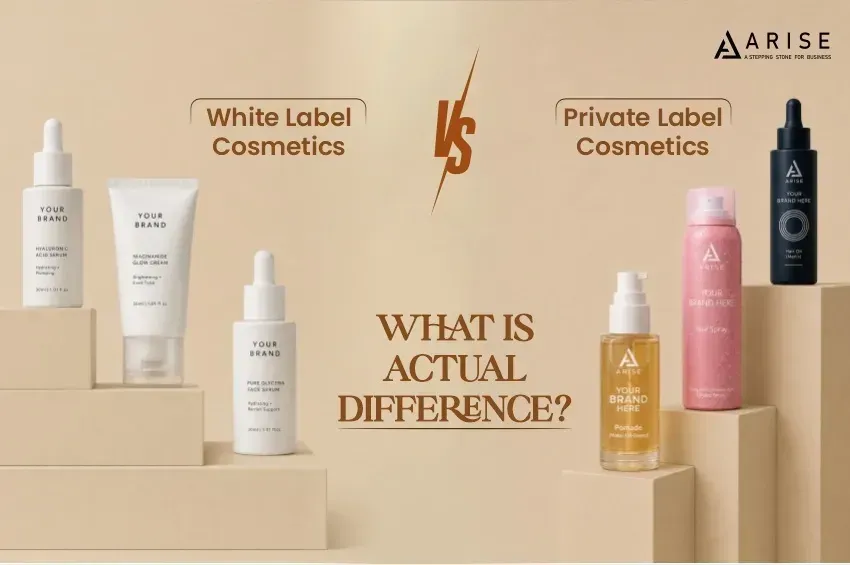
Introduction
Most cosmetic brand founders ask the wrong question when comparing white label and private label. They ask which is cheaper or faster. The better question is: which model will your brand outgrow first?
Both options let you sell products under your own name without setting up a factory. But they are built for different stages of brand growth. The difference shows up in formulation control, product exclusivity, pricing at scale, and how defensible your brand becomes over time.
If you are deciding between white label and private label for your next launch, here is what actually matters.
What Is White Label Cosmetics?
White label cosmetics are ready-made products manufactured by a third party and sold by different brands under their own labels.
In this model, the manufacturer has a ready formulation. You select the product, add your brand name, choose from available packaging options, and launch. The same face wash, shampoo, sunscreen, body lotion, or hair serum formula may be sold by multiple brands with different packaging.
This model works well when speed is your main priority. You do not need to spend time on R&D, ingredient selection, testing, or formulation trials. However, a white label gives you a product to sell – not a product that is unique to your brand.
What Are the Benefits of White Label Cosmetics?
Faster time to market: Products are already formulated and stability-tested. A brand can go from brief to first batch in weeks.
Low minimum order quantities: White label is accessible for founders who are not yet ready to commit to large minimum order quantities.
- No R&D cost: You skip formulation development entirely. The manufacturer has already done that work.
- Regulatory compliance included: Products already meet applicable standards, and the manufacturer handles safety documentation.
Lower entry investment: For a first-time founder validating a concept, white labelling reduces the financial risk of getting started.
What Are the Limitations of White Label Cosmetics?
Limited exclusivity: In most white label models, the same formulation may be available to other brands unless exclusivity is agreed in writing.
No IP ownership: You cannot take the formula to another manufacturer if you decide to switch. The formula belongs to the factory.
- Limited customisation: White label usually allows changes in branding, label, and packaging. The formulation is fixed.
- Cost advantage reduces at scale: White label can be easier for small launches, but private label typically offers better per-unit economics at higher volumes.
Hard ceiling on brand differentiation: When your product is identical to a competitor’s, your brand story and packaging are the only differentiators. That is a fragile position in a competitive category.
Begin your cosmetic brand journey with white-label products that are ready to go to market.
What Does Private Label Actually Mean in Cosmetics?
Private label cosmetics are products manufactured by a third-party cosmetic manufacturer for your brand, with more control over formulation, packaging, claims, and positioning.
In this model, your brand works closely with the manufacturer. You may modify an existing base formulation or develop a custom formulation based on your product brief. This can include ingredients, texture, fragrance, product format, packaging type, target concern, and skin or hair type suitability.
Private label does not always mean starting from zero. It means your product is developed more closely around your brand’s audience, category, and market goals.
A note on formula ownership
Formula ownership in private label is not automatic. It depends entirely on your contract. Before signing any manufacturing agreement, confirm in writing who owns the formulation, whether it can be produced by another manufacturer, and what happens if the relationship ends. A credible manufacturing partner will have clear terms on this – and will not avoid the conversation.
What Are the Benefits of Private Label Cosmetics?
- Possible formulation exclusivity: Private label can offer stronger exclusivity when the formulation is developed for your brand and protected through clear agreement terms.
- Long-term IP and brand equity: Owning your formulation – with the right contract – builds defensibility that white label cannot match.
- Genuine differentiation: Your ingredient story, texture, and actives can be built around your positioning, not borrowed from a shared catalogue.
- Better economics at scale: Private label per-unit costs drop significantly at higher volumes, improving margins as the brand grows.
- Supports retailer listings and D2C premium positioning: Retailers and distributors expect exclusivity. White label rarely satisfies that requirement at any meaningful scale.
What Are the Limitations of Private Label Cosmetics?
- Higher upfront investment: R&D, stability testing, and development work come at a cost before the first unit is produced.
- Longer development timeline: Custom formulation work takes weeks to months, depending on the complexity of the brief and revision cycles.
- Higher MOQ: Private label typically requires comparatively higher minimum order quantities to offset development and exclusivity commitments.
- Dependent on manufacturer R&D capability: Not every manufacturer has genuine in-house formulation expertise. A private label arrangement is only as strong as the R&D team behind it.
Move beyond standard products and build a private label range that actually belongs to your brand.
White Label vs Private Label - Side-by-Side Comparison
| Factor | White Label Cosmetics | Private Label Cosmetics |
|---|---|---|
| Formula ownership | Manufacturer retains ownership | Brand (if contract specifies) |
| Product exclusivity | None – any brand can order it | Full – produced only for your brand |
| Customisation scope | Label and packaging only | Ingredients, actives, fragrance, texture, packaging |
| Minimum order quantity | Low | Higher |
| Time to market | Weeks | Weeks to months |
| Per-unit cost at scale | Higher | Lower |
| Long-term brand defensibility | Low | High |
The simplest way to understand the difference is this:
White label helps you enter the market quickly. Private label helps you build a product that belongs more strongly to your brand.
Neither model is automatically better. The right choice depends on your current stage, budget, timeline, and brand ambition.
Which Model Should You Choose Based on Where Your Brand Is Right Now?
The right model depends on your brand stage, budget, product goals, and launch timeline.
If you are still testing an idea or want to enter the market quickly, white label can be a practical starting point. It helps you launch faster and understand customer demand with less product development work.
If you are building a serious D2C brand, salon brand, or entering categories like baby care, intimate hygiene, men’s grooming, or professional haircare, private label is usually the stronger choice. These categories need clearer positioning, better formulation control, and stronger consumer trust.
For established cosmetic brands, private label also makes more sense. You already understand your customers, product gaps, and growth opportunities.
Choose White Label If:
- You need a quick launch
- You want to test a category before committing
- You have limited product development knowledge
- Your main focus is branding and distribution
- You are not ready for custom formulation yet
Choose Private Label If:
- You want a differentiated product
- You understand your target audience well
- You want more control over ingredients and product claims
- You plan to scale seriously
- You want a long-term manufacturing partnership
Why Choosing the Right Model Matters for Your Brand
Your manufacturing model directly affects product experience, pricing, repeat purchase, and brand reputation.
A good logo, packaging, or social media strategy cannot fix a weak or generic product. If the formulation does not meet customer expectations, people will not buy again. If quality changes from batch to batch, trust drops.
White label may help you launch faster, but it can limit differentiation and pricing power later. Private label needs more planning, but it supports stronger positioning, better consistency, and long-term customer loyalty.
This decision is not just about manufacturing. It is about building the right foundation for your brand.
Build your cosmetic brand on the model that supports your launch, scale, and product goals.
How Arise Cosmetic Works With You - Whichever Model You Choose
Arise Cosmetic manufactures across skincare, haircare, baby care, men’s grooming, and intimate hygiene – supporting brands at every stage, from first launch to full-scale production.
If you are starting out, Arise helps you identify whether white label or private label is the right fit for your product category, timeline, and budget. If you are ready to develop a custom formulation, Arise’s in-house R&D team works with you directly – from ingredient selection and texture development through stability testing, safety documentation, and packaging coordination.
Every product is manufactured in a GMP-certified, ISO 22716-compliant, FDCA-approved facility. Your formulations meet regulatory requirements from day one.
What brand founders get:
- Formulation trials and revision cycles managed in-house
- Stability and safety testing handled before any batch goes to production
- Packaging sourcing and coordination included in the process
- Compliance documentation prepared for Indian regulatory requirements
- Consistent product quality across batches – not just the first order
Whether you are placing your first order or scaling an established line, Arise manages the full process from brief to delivery.
Conclusion
White label and private label cosmetics both help you launch products under your own brand name, but they serve different goals.
White label suits quick market entry and early-stage testing. Private label is the stronger choice when you want formulation control, stronger positioning, and long-term brand growth.
For serious cosmetic brand founders, the right choice depends on your brand stage, target audience, product category, and future plans.
If you want to build a cosmetic brand with better product ownership and reliable manufacturing support, Arise Cosmetic can help you choose the right path.
Contact us today to discuss your cosmetic manufacturing requirements.
About the Author

Arise Cosmetic
Arise Cosmetic is a GMP-certified, ISO-compliant, FDCA-approved private label cosmetic manufacturer based in Gandhinagar, Gujarat. Founded in 2017, the team has developed 2,000+ formulations across hair care, skin care, baby care, men's grooming, and intimate hygiene. Arise Cosmetic works with D2C brand founders, salon owners, direct selling companies, and first-time beauty entrepreneurs across Globally, guiding them from formulation brief to bulk delivery under one roof.
1.What is a private label in cosmetics?
A private label in cosmetics means a third-party manufacturer produces products sold under another brand’s name, letting businesses offer their own cosmetic lines without needing their own factories.
2. Can I launch a cosmetic brand without manufacturing?
Yes, you can launch a cosmetic brand without manufacturing by using private label services. This lets you focus on branding and sales while a third party handles production.
3. How long does it take to launch a private label cosmetic line?
Launching a private label cosmetic line typically takes 3 to 9 months, depending on product complexity, customisation, and regulatory approvals.
4. What’s the minimum order quantity for private label cosmetics?
The minimum order quantity (MOQ) for private label cosmetics is typically 1000 units per variant, though this can vary by manufacturer and product.