There is no item in your cart
Table of Contents
ToggleTable of Content
Start Your Cosmetic Brand Today!
Introduction
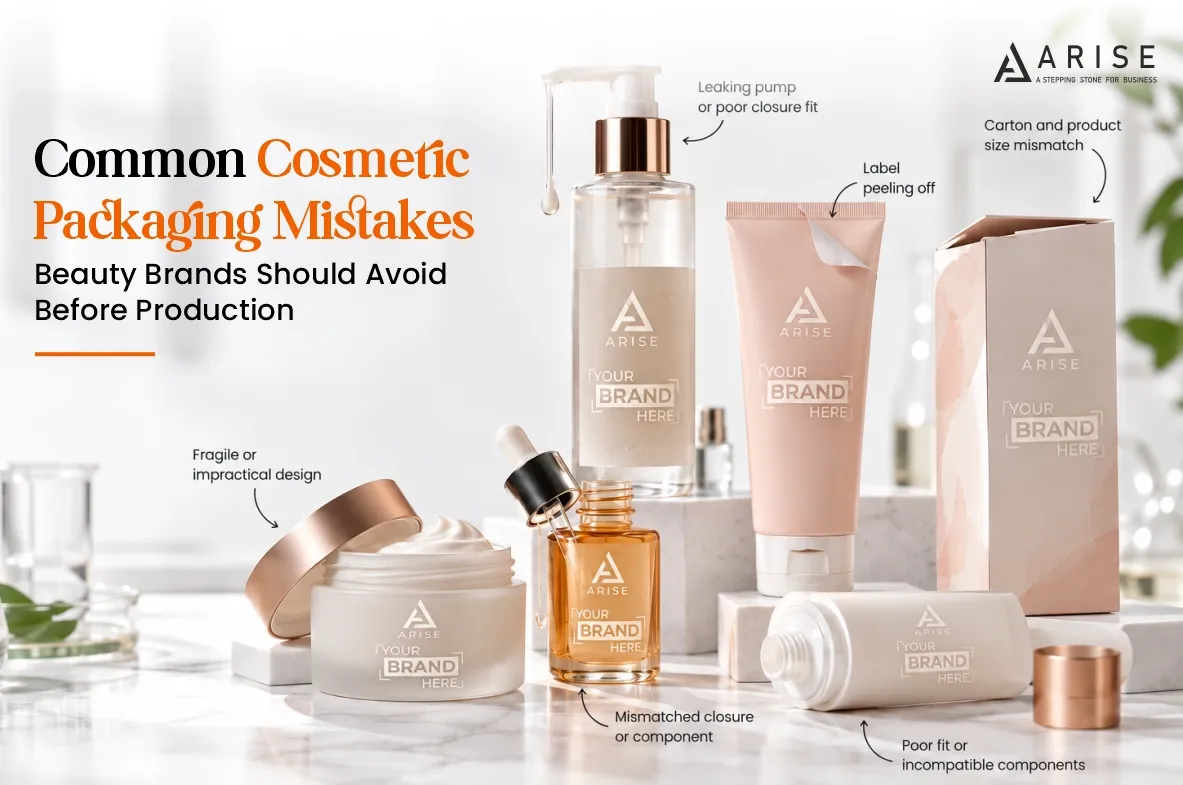
Cosmetic packaging problems often start long before production begins.
A pack may look right on a supplier catalogue or design mock-up, but that does not mean it will work with the finished formulation, dispensing system, filling process or storage conditions. Problems usually appear when packaging decisions are locked too early, before the product and production requirements are fully understood.
That is why avoiding common cosmetic packaging mistakes is less about choosing the “best-looking” bottle, jar or tube and more about making the right decisions in the right order.
This guide covers the key packaging mistakes beauty brands should check before bulk production starts.
Quick Summary
Many cosmetic packaging problems start with decisions made too early. A brand may choose a bottle before the formula is ready, skip compatibility checks, overlook filling or sealing needs, or finalise artwork before the required label information is confirmed. The best way to avoid these issues is to review the formula, packaging, filling, labelling and order quantity together before bulk production begins.
Key Takeaways
- Finalise the packaging once the formula and product requirements are clear.
- Check the formula with the intended bottle, jar, tube, pump or closure where needed.
- Make sure the packaging works with the filling and sealing process before bulk ordering.
- Confirm label requirements before the artwork is finalised.
- Match the packaging MOQ and lead time with the production plan.
- Keep one final approved packaging reference for suppliers, quality and production teams.
Cosmetic Packaging Mistakes at a Glance
| Common Mistake | What Can Go Wrong | Better Approach |
|---|---|---|
| Choosing the pack too early | Formula and pack may not work together | Confirm the product requirements first |
| Skipping compatibility checks | Leakage, pack damage or product changes | Check the formula in the intended pack |
| Choosing the wrong dispenser | Pumping or dispensing problems | Match it to the formula |
| Ignoring filling requirements | Problems during filling or sealing | Check samples before bulk ordering |
| Leaving labelling until late | Not enough space for required information | Review declarations before artwork |
| Printing artwork too early | Reprinting and wasted stock | Lock product and pack details first |
| Ignoring packaging MOQ | Excess unused packaging | Match packaging quantity to production |
| Skipping transit checks | Leakage or damage during delivery | Consider the complete packed product |
| No final approved pack | Different versions reach production | Keep one approved reference |
Why Cosmetic Packaging Decisions Need to Be Finalised Before Production
Packaging sits between the formulation and the customer.
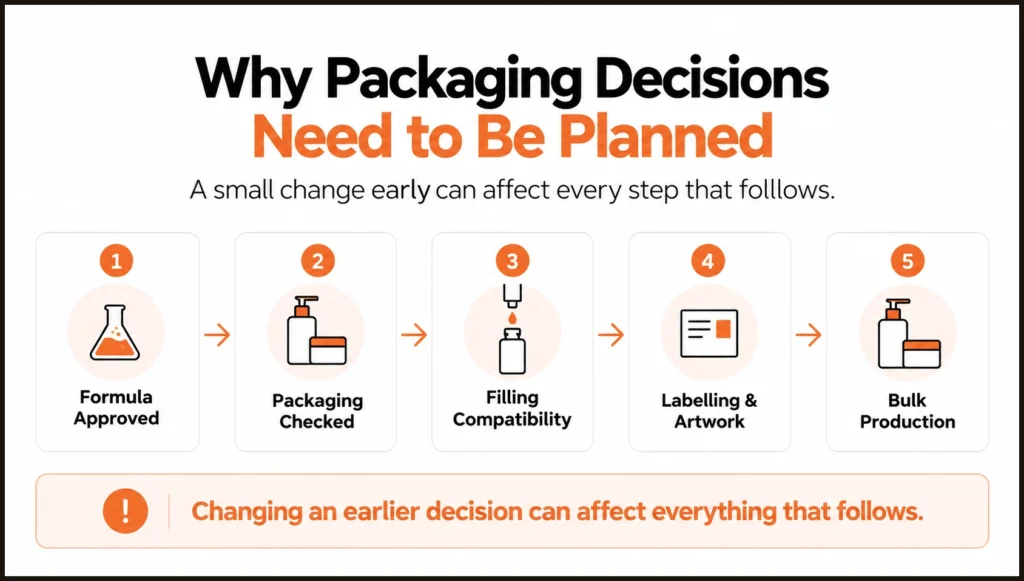
The formula decides what the packaging needs to protect. The dispenser decides how the customer actually uses the product. The bottle, jar or tube has to work with the filling and sealing process on the manufacturing line. The label needs enough space for the declarations it is legally required to carry. The complete pack, finally, needs to survive storage and distribution before it ever reaches a shelf.
If one of these decisions changes late, several of the others usually have to change with it. Changing a cream’s viscosity can affect which pump actually works. Switching from an opaque bottle to a clear one can change how much protection a light-sensitive formula gets. Changing the container size can affect the label layout, the carton dimensions and the filling line setup all at once.
This is why packaging works best as part of product development, not as a separate branding exercise finished before the formula is locked. Arise Cosmetic supports sample production, stability testing, packaging compatibility checks, filling and bulk production as part of one connected manufacturing process.
9 Common Cosmetic Packaging Mistakes to Avoid Before Production
1. Choosing Packaging Before the Formula Is Finalised
It is natural to start looking at bottles and jars early. Packaging is one of the most visible parts of a new product.
But appearance should not be the only reason for choosing it.
A few product details can change what packaging will work:
| Product Factor | Why It Matters |
|---|---|
| Thickness of the formula | Affects the pump or opening needed |
| Sensitivity to light or air | Can affect the type of container |
| Fill quantity | Determines the suitable pack capacity |
For example, a pump selected for a light lotion may not work as well if the final formula becomes much thicker.
Explore packaging early if needed, but finalise it once the formula and product requirements are clear enough to make the right decision.
2. Assuming Compatibility Without Testing in the Final Pack
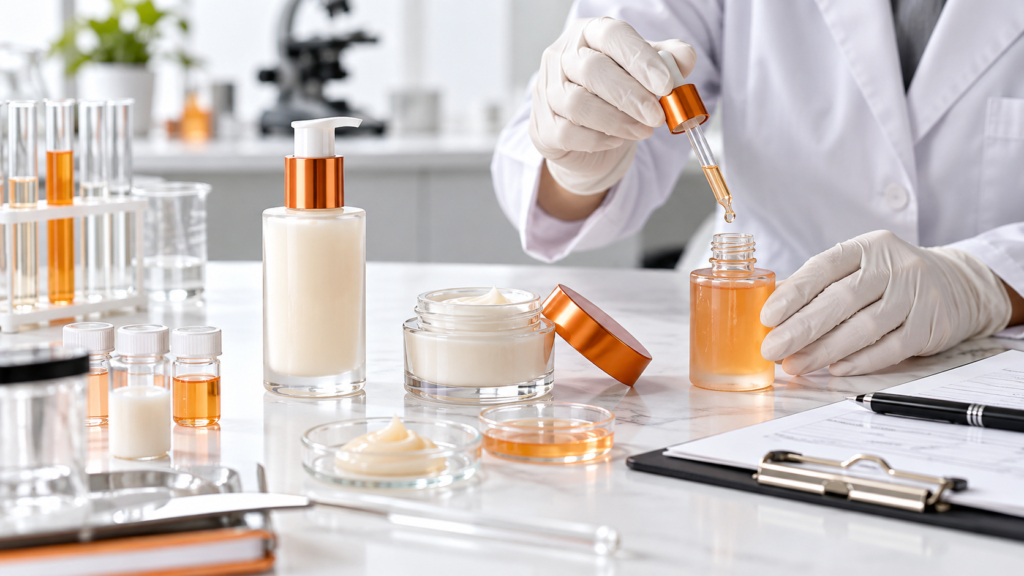
A formula can look completely fine in the lab but behave differently after spending weeks or months in its final bottle, jar or tube.
The product can come into contact with more than the container itself. Pumps, seals, liners and droppers can also react differently over time.
Possible problems include:
- leakage
- changes in colour or smell
- packaging becoming soft or brittle
- pumps that stop working properly
This is why packaging compatibility matters.
ISO/TR 18811:2018, which provides guidance on cosmetic stability testing, also considers the interaction between the cosmetic product and its packaging.
For the final compatibility assessment, use the packaging that is actually planned for the product, including the closure or dispenser where relevant.
3. Picking the Wrong Pump, Dropper, Cap or Dispensing Format
A dispenser should match the formula, not just the look of the product.
A thick cream can be difficult to push through a pump designed for a lighter lotion. A large opening can release too much of a watery formula. A dropper may look right for a serum but still deliver more or less product than intended.
Before approving a dispenser, ask three simple questions:
- Does the formula come out easily?
- Does it dispense the right amount?
- Will the customer be able to use it comfortably?
If the bottle and pump come from different suppliers, also check that they fit properly together.
This simple test can prevent a pack that looks good but becomes frustrating to use.
4. Ignoring Filling-Line and Sealing Fit
A packaging sample can work perfectly by hand and still cause problems during production.
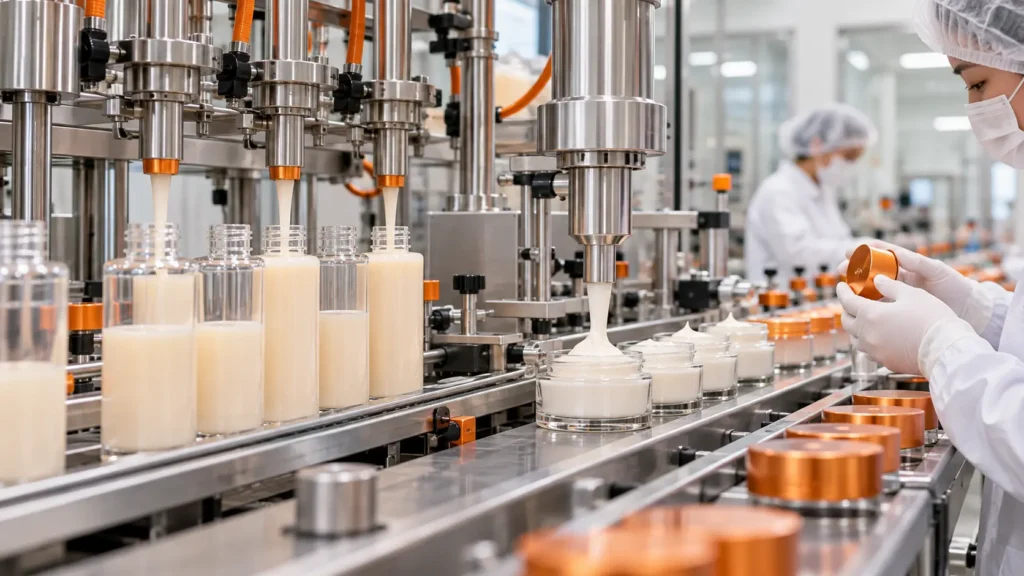
The bottle opening has to work with the filling process. Tubes need to seal correctly. Jars may need to work with foil sealing. Unusual bottle shapes can sometimes need additional handling during filling or labelling.
You do not need to understand every machine specification as a brand owner.
What matters is sending the proposed packaging to your manufacturer before placing the full packaging order so they can check whether it suits the production setup. A trial fill may also be useful for some products and packaging formats.
Arise Cosmetic operates filling equipment for bottles, jars, tubes and sachets, so checking how the selected packaging works with the production process is an important part of planning.
5. Missing Cosmetics Rules, 2020 Labelling Requirements
A beautiful label still needs enough room for the required cosmetic label information.
For cosmetics sold in India, the Cosmetics Rules, 2020, as amended, include labelling requirements for information such as the product name, manufacturer details, batch and licence information, net contents, expiry or use-before information and applicable warnings.
Retail cosmetic packs may also need declarations under the Legal Metrology (Packaged Commodities) Rules, 2011, where applicable.
This becomes more difficult with lip balms, small bottles and travel-size products where label space is limited.
The practical lesson is simple: confirm what needs to appear on the pack before the artwork is finalised.
That prevents the design team from having to squeeze important information into whatever space is left.
6. Finalising Artwork Before Specifications and Compliance Are Locked
Artwork often starts while other product details are still changing.
That becomes a problem when the brand later changes:
- product information
- claims
- ingredients
- pack dimensions
- net quantity
- required declarations
By then, labels, cartons or printed tubes may already be ready for production.
Before sending artwork for printing, confirm the final product information and packaging dimensions first.
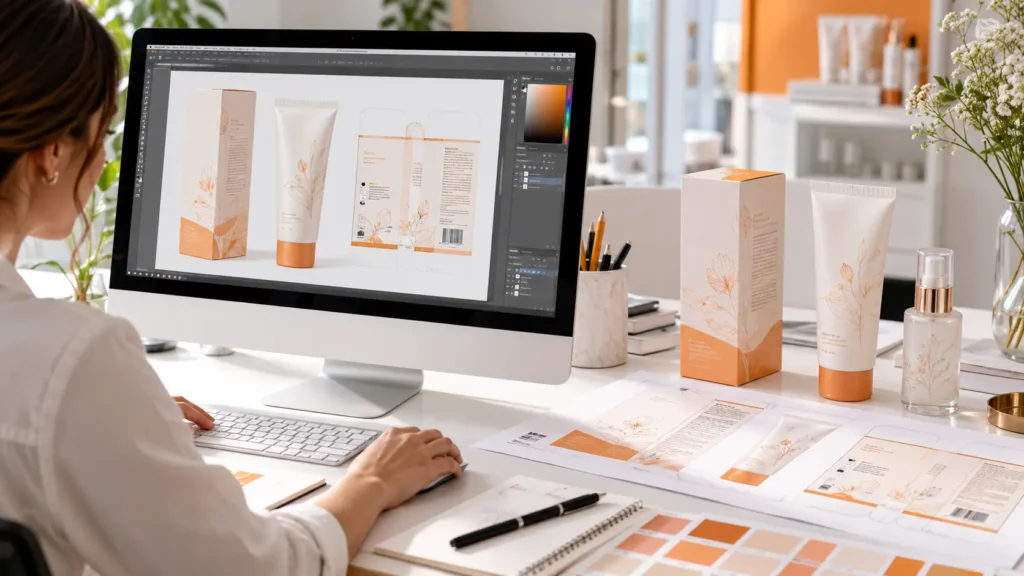
A digital PDF is also not always enough to judge how small text, colours, foil or other finishes will look on the actual material. Where needed, review a physical or production sample before approving the full print run.
7. Ordering Custom Packaging Without Checking the MOQ
Packaging suppliers and cosmetic manufacturers do not always work with the same minimum order quantity.
A custom bottle colour, printed tube, special pump or custom mould may require a much larger order than the brand’s first product batch.
For Example:
| Production Plan | Packaging Situation |
|---|---|
| Small first launch | Stock packaging may be easier to manage |
| Growing repeat orders | More customisation becomes practical |
| Established high volume | Custom moulds or components may make more sense |
Arise Cosmetic provides a private-label MOQ starting from 1,000 units per variant. The packaging supplier, however, may have a different MOQ.
Compare both quantities before committing.
Stock bottles, jars or tubes with customised labels and cartons can sometimes be a more practical starting point than developing completely custom packaging from day one.
Also check lead time. A custom bottle that takes much longer to source can delay production even when the formula is ready.
8. Skipping Transit and E-commerce Handling Tests
Packaging has another job after filling: getting the product safely to the customer.
During storage and delivery, the pack may be stacked, turned on its side, exposed to heat or handled several times.
This matters particularly for:
- glass bottles
- liquids
- pumps
- droppers
- products sold online
A bottle may not leak while sitting upright on a table but could behave differently during courier transport.
Look at the complete packed product, including its carton and shipping packaging where relevant. The level of testing should depend on the product, packaging and distribution route.
9. Going Into Production Without a Final, Approved Packaging Specification
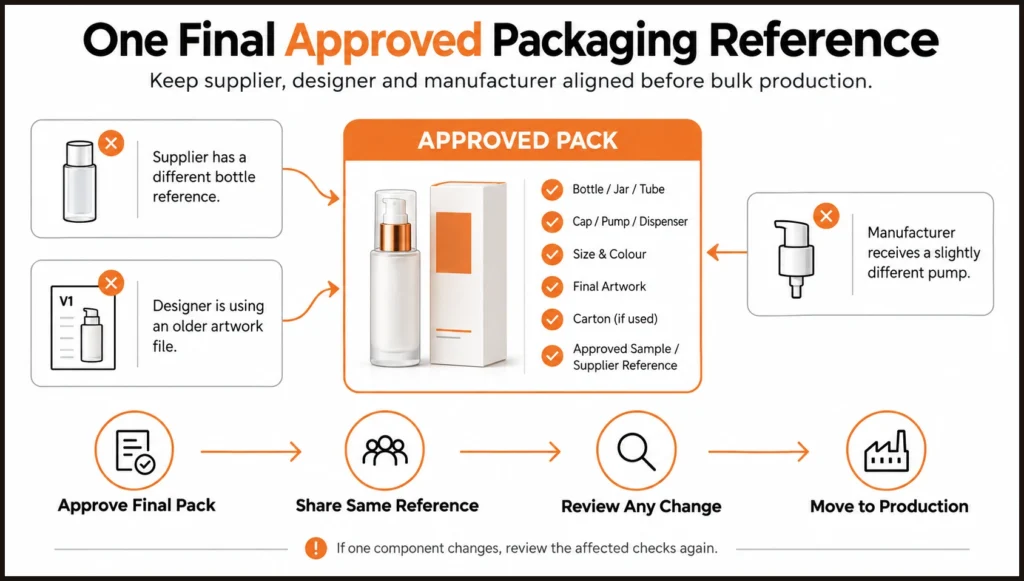
One last problem appears when different people are working from different versions.
The packaging supplier may have one bottle reference. The designer may have an older artwork file. The manufacturer may receive a slightly different pump.
Before bulk production, keep one approved reference for the final pack.
It should make clear:
- which bottle, jar or tube is approved
- which cap, pump or dispenser goes with it
- the size and colour
- the final artwork
- the carton, if used
- an approved sample or supplier reference
Two pumps can look almost identical and still have different internal parts. The same applies to bottles from different suppliers.
A clear final reference helps everyone work with the same packaging.

Cosmetic Packaging Pre-Production Checklist
Before approving packaging for bulk production, check that:
- Formula approved: The final sample and key product characteristics are confirmed.
- Packaging format confirmed: The material, container and dispenser suit the formula and intended use.
- Compatibility assessed: The formula has been evaluated with the intended primary pack and closure where required.
- Filling fit checked: Filling, sealing, closure application and dispensing requirements have been confirmed.
- Labelling reviewed: The artwork accounts for applicable Cosmetics Rules, 2020 and relevant product standards.
- Claims finalised: Product and environmental claims have been reviewed before printing.
- Artwork approved: The final dieline, declarations and production artwork are locked, with a physical or production-representative proof reviewed where needed.
- MOQ and lead time confirmed: Packaging quantities and procurement timelines match the production plan.
- Transit requirements considered: The finished pack and outer shipping carton suit the expected distribution route.
- Final specification locked: Purchasing, quality and production teams are working from the same approved packaging specification or master reference.
This checklist is a useful starting point, but the exact checks will depend on the formulation, packaging format, product category and market.
Conclusion
Most cosmetic packaging mistakes do not happen because a brand chooses an unattractive bottle or jar. They happen when packaging is approved before the product, production and labelling requirements are clear.
Explore packaging during product development, but confirm how it works with the formula, dispenser and filling process before committing to a bulk order. Then finalise the label, artwork and packaging quantity.
At Arise Cosmetic, packaging is handled as part of the wider product development and manufacturing process, alongside formulation, testing and filling.
If you are finalising your formula and packaging, contact our team to discuss your product and packaging requirements before moving into production.
FAQs
Q1. What should a beauty brand check before approving cosmetic packaging?
Check whether the pack suits the formula, dispenser and filling process. Also confirm the required label information, artwork, packaging quantity, lead time and delivery requirements before bulk production.
Q2. How do you know if cosmetic packaging is compatible with a formulation?
The formula should be assessed in the intended packaging where required. Look for changes such as leakage, discolouration, odour changes, damage to the container or problems with the pump or closure.
Q3. Which packaging material is best for cosmetic products??
There is no single best material. Plastic, glass, aluminium and other options suit different formulas and product formats. Consider formula sensitivity, dispensing, transport, cost and the protection the product needs.
Q4. Should a new beauty brand choose stock or custom cosmetic packaging?
Stock packaging can be a practical option for an early launch because it may require less development time and lower packaging commitments. Custom packaging offers more differentiation but can involve higher MOQs, tooling costs and longer lead times.
About the Author

Arise Cosmetic
Arise Cosmetic is a GMP-certified, ISO-compliant, FDCA-approved private label cosmetic manufacturer based in Gandhinagar, Gujarat. Founded in 2017, the team has developed 2,000+ formulations across hair care, skin care, baby care, men's grooming, and intimate hygiene. Arise Cosmetic works with D2C brand founders, salon owners, direct selling companies, and first-time beauty entrepreneurs across Globally, guiding them from formulation brief to bulk delivery under one roof.