
There is no item in your cart
Request a Free Quote
Table of Contents
ToggleTable of Content
Start Your Cosmetic Brand Today!
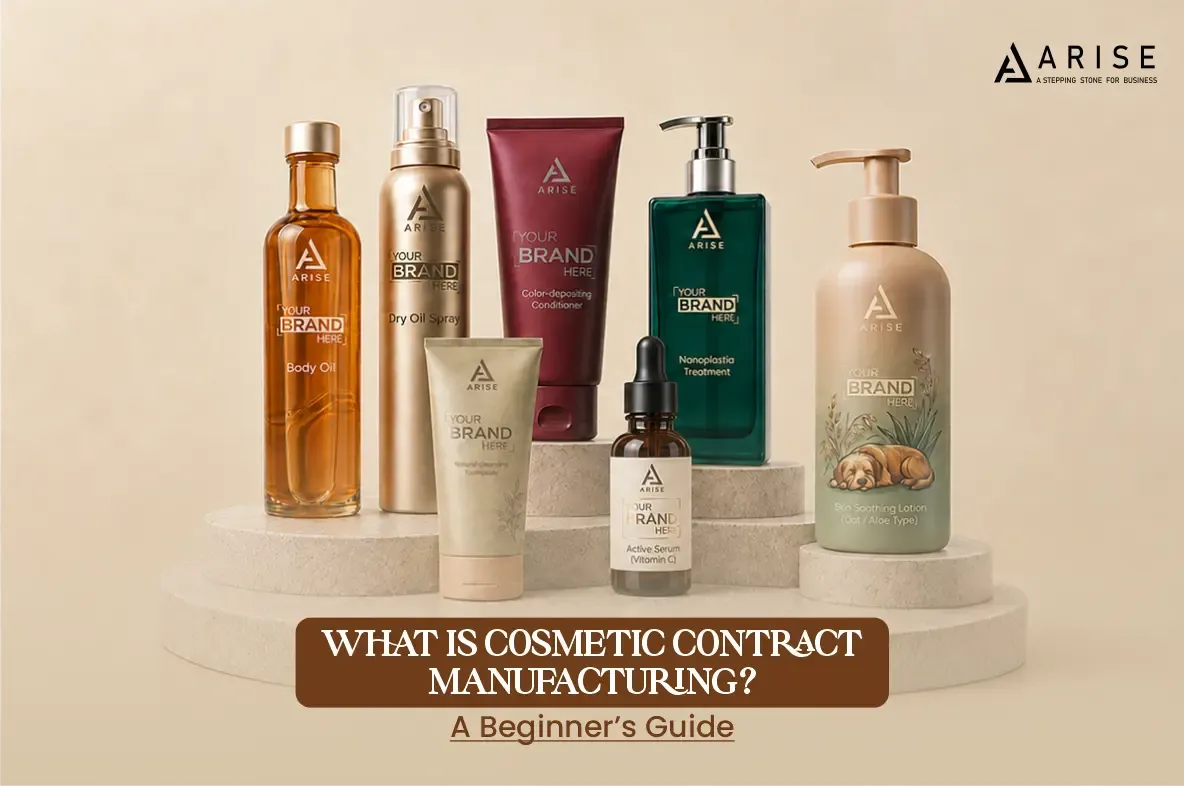
Introduction
Launching a cosmetic brand takes more than choosing a name and packaging. You need a workable formula, suitable raw materials, product testing, compliant labels and consistent production.
Building these capabilities in-house requires major investment and technical expertise. Cosmetic contract manufacturing allows a brand to work with an established manufacturer that can develop and produce market-ready products.
This guide explains how the model works and what founders should check before choosing a manufacturing partner.
Quick Summary
Cosmetic contract manufacturing means you direct the formulation and the manufacturer produces it under GMP conditions, on contract. That is different from private label, which starts from a ready-made formula, or white label, sold to multiple brands under different names. The process moves from brief to sample to bulk production to dispatch, and MOQ and cost shift with how complex your formula is. In India, the manufacturer also needs a valid licence under the Cosmetics Rules, 2020.
Key Takeaways
- Cosmetic contract manufacturing lets brands outsource formulation, testing, production and packaging without building their own facility.
- It offers more product customisation than white-label or standard private-label models.
- Formula ownership, exclusivity, MOQ, timelines and testing responsibilities should be confirmed in writing.
- Brands should verify licences, GMP systems, quality records and product-category experience before choosing a manufacturer.
- A clear product brief helps the manufacturer provide a more accurate quotation and development plan.
What Is Cosmetic Contract Manufacturing?
Cosmetic contract manufacturing is a business arrangement where a brand hires a manufacturer to produce its cosmetic products according to an agreed formulation, specification and quality standard.
The brand usually directs the formulation, whether that means providing its own formula or working with the manufacturer’s R&D team to develop one, and the manufacturer handles production, quality control and packaging under those instructions.
It suits brand founders who want more control over what goes into their product than a ready-made formula allows, without the capital and compliance burden of setting up their own manufacturing facility.
How Is Contract Manufacturing Different from Private Label, White Label, OEM, ODM and Third-Party Manufacturing?
These terms often overlap, so focus on the actual service scope rather than the label alone.
Private label usually starts with an existing formula that allows limited customisation, while white label generally offers the same ready-made product to multiple brands with minimal changes beyond packaging and branding.
Contract manufacturing may involve producing a brand-provided formula or developing a custom formulation from a product brief.
OEM generally follows the brand’s formula or specifications, while ODM usually starts with a product or formula developed by the manufacturer.
Third-party manufacturing is a broader term used for any arrangement in which an external company manufactures products for another brand.
What Does Each Cosmetic Manufacturing Model Usually Include?
| Model | Formula Source | Customisation | Typical Speed | Formula Rights |
|---|---|---|---|---|
| White Label | Ready-made formula | Very limited | Fastest | Usually manufacturer-owned |
| Private Label | Existing or adaptable formula | Limited to moderate | Fast | Usually manufacturer-owned |
| ODM | Manufacturer-developed formula | Moderate | Moderate | Contract-dependent |
| OEM | Brand formula or specifications | High | Longer | Contract-dependent |
| Contract Manufacturing | Brand formula or custom development | Moderate to high | Varies by project | Contract-dependent |
| Third-Party Manufacturing | Depends on the arrangement | Varies | Varies | Contract-dependent |
Which Manufacturing Model Is Better for a First-Time Cosmetic Brand?
A ready private-label formula may suit a founder who wants a quicker launch with lower development requirements. Custom contract manufacturing may suit a brand that needs a distinctive texture, ingredient profile or product performance.
Choose based on your budget, launch timeline and need for differentiation. No single model works best for every brand.
Also Read: How to Start Your Own Cosmetic Brand with Private Label Manufacturing in India
How Does the Cosmetic Contract Manufacturing Process Work?
The process generally runs through the following stages.
- You share your product brief, including category, target audience, ingredient preferences and any formulation direction.
- The manufacturer’s R&D team develops a sample based on that brief.
- You review the sample and request revisions until it meets your expectations.
- Once approved, the manufacturer sources raw materials and packaging at bulk scale.
- Production runs under GMP-controlled conditions.
- The batch goes through quality checks, including stability testing.
- The finished product is packed, labelled and dispatched to you.
How Is Quality Controlled During Cosmetic Manufacturing?
Quality control runs through the batch, not just at the end of it. A manufacturer working to GMP and ISO 22716 standards checks parameters such as pH, viscosity and microbial load at defined points, keeps documented batch records, and runs stability testing to confirm the product holds up over its intended shelf life and under real storage conditions.
In India, licensed cosmetic manufacturers must maintain raw-material and batch records and test each lot of raw materials and every finished batch according to applicable requirements.
Turn your cosmetic product idea into a market-ready batch with controlled manufacturing support.
Who Owns the Formula, Packaging and Product Intellectual Property?
Ownership depends on the agreement. A manufacturer may retain a standard base formula, while a custom-development contract may assign ownership or exclusive-use rights to the brand.
Do not assume a development fee gives you full ownership. Clarify this before bulk production.
Which Ownership and Confidentiality Terms Should Be Written into the Agreement?
The agreement should state:
- A clear clause stating who owns the final formula.
- A non-disclosure agreement covering both the formula and your brand’s business details.
- An exclusivity clause, stating whether the manufacturer can sell an identical or near-identical formula to another brand.
- What happens to the formula if you decide to move production to a different manufacturer later.
- Ownership of packaging design and artwork, separate from the formula itself.
Still working out your ownership and exclusivity terms? Share your product brief with our team and we will walk you through how we structure these agreements before any production begins.
Which Licences, Quality Systems and Tests Should an Indian Cosmetic Brand Check?
In India, State Licensing Authorities issue licences for domestic cosmetic manufacturing. The Cosmetics Rules, 2020 provide for a manufacturing licence in Form COS-8 and a loan licence in Form COS-9. Imports and permissions for new cosmetics involve the Central Licensing Authority.
Ask for current compliance documents covering the correct facility and product categories. Do not rely only on terms such as “approved” or “certified.”
Which Manufacturing Credentials Should the Brand Verify?
- A valid manufacturing licence under the Cosmetics Rules, 2020.
- GMP certification, confirming the facility follows Good Manufacturing Practice.
- ISO 22716 certification, the international standard specific to cosmetics GMP.
- FDCA registration, the state licensing credential for facilities based in Gujarat. If your manufacturer is elsewhere, confirm the equivalent State Licensing Authority credential for that state instead.
- BIS certification, where it applies to your specific product category. Requirements here can be product-specific, so confirm current applicability with the manufacturer rather than assuming one standard covers every category.
Which Quality and Testing Records Should the Brand Request?
- Stability test reports for your specific formulation.
- Microbial and preservative efficacy test reports.
- Batch manufacturing records for past production runs.
- A certificate of analysis for finished batches.
- Documentation supporting any claims you plan to make on pack, such as dermatologically tested or cruelty-free.
What Are the Main Benefits and Risks of Cosmetic Contract Manufacturing?
Like any manufacturing model, this one has a real upside and a few things worth planning for honestly.
What Benefits Can Contract Manufacturing Offer a Cosmetic Brand?
- Lower upfront capital than building and licensing your own manufacturing facility.
- Access to a formulation team’s expertise without hiring one in-house.
- A formula you own, rather than one shared across a catalogue.
- Scalability, since production can grow with your order volumes without new infrastructure on your end.
- Compliance support, with an experienced manufacturer typically helping you navigate documentation requirements.
What Risks Should a Cosmetic Brand Plan For?
- You depend on the manufacturer’s capacity and reliability for your own delivery timelines.
- Quality can vary batch to batch if the manufacturer’s QC oversight is weak, which is why verifying their process matters before signing.
- Ownership terms that are not written clearly can leave you without control of your own formula.
- MOQs tie up working capital, so match them to a realistic sales forecast rather than the lowest quoted price.
- Fully custom formulation development takes longer than picking a ready-made private label product, so plan your launch timeline accordingly.
Create your cosmetic product with a manufacturing process that supports clarity from agreement to batch release.
Is Cosmetic Contract Manufacturing Right for Your Brand?
If you want more ownership over your formula and are prepared for a slightly longer development runway than a ready-made product, contract manufacturing is generally a good fit.
If you need to launch fast on a tight budget to test a category, private label or white label may make more sense as a first step.
Which Types of Cosmetic Businesses Benefit Most from This Model?
- D2C and e-commerce brands that want a formula competitors cannot simply reorder from the same catalogue.
- Salon and professional brands building a retail line around their existing reputation.
- Established brands expanding into a new category, such as a skin care brand moving into men’s grooming or baby care.
- Brands that validated demand with a private label product and now want to own a differentiated formula for the next stage of growth.
How Should You Evaluate a Cosmetic Contract Manufacturer?
Evaluating a cosmetic contract manufacturer properly upfront saves far more time than fixing a mismatch after production has started.
What Should You Verify Before Selecting a Manufacturer?
- Current GMP, ISO 22716 and relevant licensing certificates, not just claims on their website.
- In-house R&D capability, rather than one that outsources formulation to a third party.
- A clear sample development timeline and process for revisions.
- MOQ flexibility that matches your stage and budget.
- Willingness to put ownership and confidentiality terms in writing before you share your brief in detail.
What Warning Signs Should You Avoid?
- No written agreement, or one that is vague about formula ownership.
- Reluctance to share certifications or facility details.
- No defined sample approval process before bulk production begins.
- Cost quotes that shift significantly after you have committed.
- No batch documentation or willingness to show you their QC process.
What Should You Prepare Before Contacting a Cosmetic Manufacturer?
The more clarity you bring to the first conversation, the more accurate the quote and timeline you get back.
Before you reach out, be ready with your product category and target audience, an indicative order volume, a budget range, your expected launch timeline, and any claims or certifications you already know you want on the label, such as organic or cruelty-free.
If you already have a formula direction or reference product in mind, share that too. It saves a round of back and forth later.
Also Read: Top 10 Questions to Ask Before Choosing a Private Label Manufacturer
What Else Do First-Time Cosmetic Brand Founders Ask?
A few questions come up often enough that they are worth answering directly.
Can a Manufacturer Develop a Cosmetic Product Without an Existing Formula?
Yes. Most contract and custom formulation manufacturers have an in-house R&D team that can build a formula from your brief and target product profile, even if you are starting with nothing more than an idea.
Can a Cosmetic Brand Start with Only One Product?
Yes. Most manufacturers support single-SKU launches, which is a practical way to test a category before committing to a full product range.
Can a Brand Switch Contract Manufacturers Later?
It depends entirely on what your original agreement says about formula ownership. This is exactly why the ownership and confidentiality terms covered earlier in this guide are worth getting right from the start, not something to revisit only when you want to leave.
Start your contract manufacturing journey with the right partner.
Conclusion
Cosmetic contract manufacturing gives founders more control over their formula and their brand’s long-term direction than private label or white label typically allow, without the cost of building an in-house factory. The trade-off is a longer development timeline and a greater need to get the agreement, the certifications and the quality checks right before you commit.
Arise Cosmetic operates as a GMP, ISO 22716 and FDCA-certified facility in Gujarat, with an in-house R&D team handling formulation development from brief to bulk production. If you have a product idea you want to build as a fully owned formula, talk to our team about your brief, your timeline and your compliance requirements.
About the Author

Arise Cosmetic
Arise Cosmetic is a GMP-certified, ISO-compliant, FDCA-approved private label cosmetic manufacturer based in Gandhinagar, Gujarat. Founded in 2017, the team has developed 2,000+ formulations across hair care, skin care, baby care, men's grooming, and intimate hygiene. Arise Cosmetic works with D2C brand founders, salon owners, direct selling companies, and first-time beauty entrepreneurs across Globally, guiding them from formulation brief to bulk delivery under one roof.