
There is no item in your cart
Request a Free Quote
Table of Contents
ToggleTable of Content
Start Your Cosmetic Brand Today!
Introduction
A 10% niacinamide serum may sound more effective than a 5% version. But does doubling the ingredient percentage actually double the results? Not necessarily.
When developing a cosmetic product, it’s easy to focus on the concentration of active ingredients. A higher percentage might look impressive on packaging, but it doesn’t tell you how well the complete formulation will perform. The right concentration depends on several factors, including ingredient quality, compatibility, skin tolerance and stability.
For cosmetic brands, understanding these factors helps avoid unnecessary formulation costs, performance issues, and late-stage product development changes.
Quick Summary
Ingredient percentages in cosmetic formulation indicate how much of each raw material a product contains, which may differ from its actual active concentration. Higher percentages don’t always improve performance because effectiveness also depends on pH, ingredient quality, delivery systems and formulation stability. Brands should select concentrations based on research, safety, regulatory requirements and product testing rather than assuming more is always better.
What Do Ingredient Percentages Mean in Cosmetic Formulation?
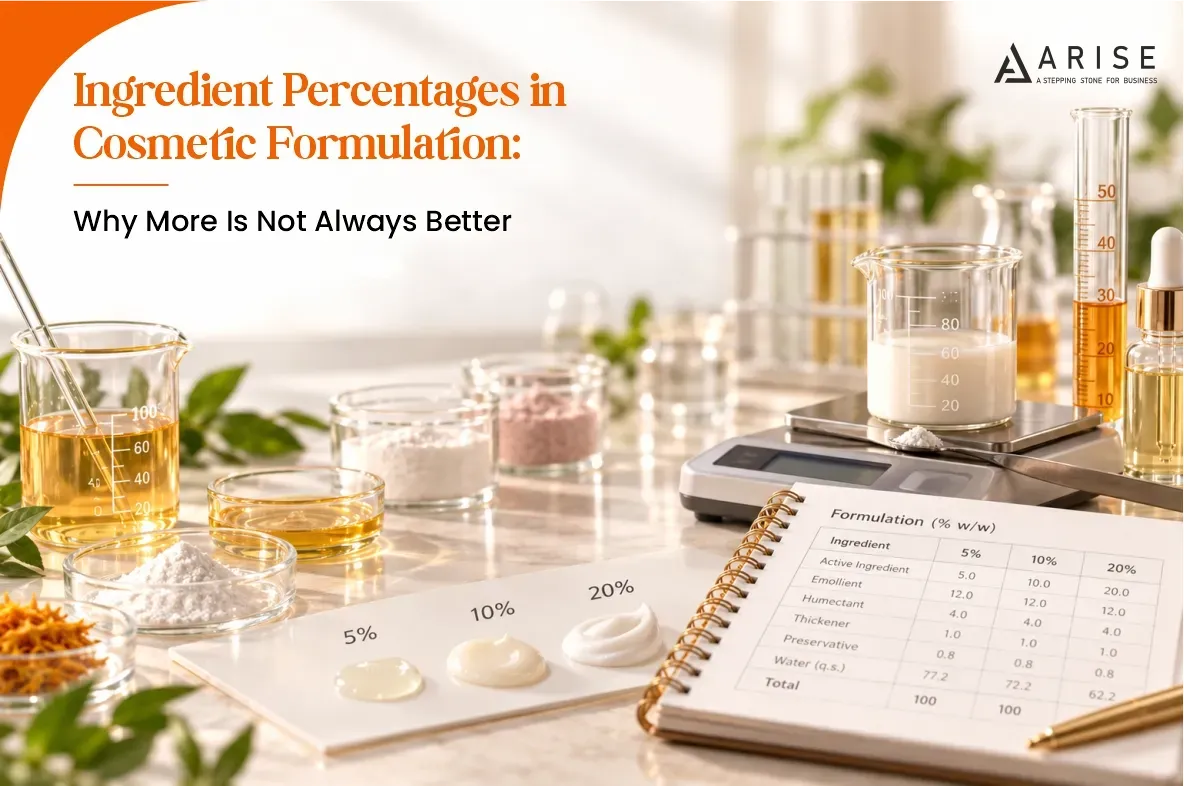
Ingredient percentages show how much of each raw material makes up a finished cosmetic formula, usually by weight (% w/w). All ingredients in a formulation add up to 100%.
For example, a 1 kg face cream containing 5% glycerin includes 50 g of glycerin. The remaining formula may contain water, emulsifiers, preservatives and other ingredients. Each serves a purpose, whether it’s providing a skincare benefit, creating the right texture or maintaining product stability.
These percentages help manufacturers maintain consistency when moving from laboratory samples to large-scale production. However, an ingredient’s percentage alone doesn’t determine how well the finished product will perform.
Is an Ingredient’s Percentage the Same as Its Active Concentration?
Not always. Many cosmetic raw materials come as solutions, blends or extracts rather than pure actives. This means the percentage added to a formula may differ from its actual active concentration.
For example, if a manufacturer adds 10% of a raw material containing 50% active substance, both measured by weight, the finished product contains 5% of that active, assuming no losses or chemical changes during manufacturing.
This distinction matters when brands compare formulations or make percentage claims on packaging. Before approving a formula, confirm whether the stated percentage refers to the raw material or the actual active content using supplier specifications.
Does a Higher Percentage of Active Ingredients Always Mean Better Results?
No. A higher percentage of an active ingredient doesn’t make a cosmetic product more effective. Some ingredients deliver the intended benefits at lower concentrations, while adding more may offer little additional improvement.
Increasing an active’s concentration can also raise raw-material costs without delivering enough additional benefit to justify the expense.
Why Do Active Ingredients Have an Effective Concentration Range?
Choosing the right concentration starts with understanding how an active ingredient performs at different levels. Formulators use clinical research, supplier data and product testing to identify concentrations that support the intended benefits.
For example, clinical studies using 5% niacinamide have shown improvements in certain skin concerns. This provides a useful reference point when developing a formulation, although the appropriate level still depends on the finished product.
Different actives also have different formulation requirements:
| Active ingredient | Main function | What influences its effective concentration |
|---|---|---|
| Niacinamide | Supports skin barrier function and improves skin appearance | Research-backed usage levels, formulation and skin tolerance |
| Vitamin C (L-ascorbic acid) | Antioxidant and skin brightening | Formulation pH, stability and skin delivery |
| Retinol | Supports skin renewal and improves signs of ageing | Skin tolerance, stability and delivery system |
| Glycolic Acid | Exfoliates the skin | Concentration, formulation pH and available free acid |
When Can Higher Ingredient Concentrations Affect Skin Tolerance or Formula Stability?
An effective cosmetic formulation needs to balance ingredient performance with skin tolerance and stability. Increasing an active ingredient’s concentration can affect that balance, depending on the ingredient and the complete formula.
For example, higher levels of exfoliating acids or retinoids generally increase the risk of dryness, redness and irritation. For cosmetic brands, poor skin tolerance can lead to customer complaints even when the product delivers its intended benefits.
Higher concentrations can also create formulation problems. Exceeding an ingredient’s solubility or compatibility limits can cause crystallisation or unwanted changes in texture and appearance.
Build your cosmetic formula with the right active concentrations, not just higher percentages.
What Factors Determine the Right Percentage of an Ingredient?
The right ingredient percentage depends on the formulation approach, how the ingredient behaves within the complete formula and how customers will use the finished product.
How Do pH, Solubility and Delivery Systems Affect Ingredient Performance?
pH: Certain active ingredients require particular pH conditions to remain stable or work effectively. For example, formulations containing L-ascorbic acid often use a relatively low pH, while vitamin C derivatives may have different requirements.
Solubility: An ingredient must be properly dissolved or dispersed in the formulation. Adding more than the base can accommodate may cause crystallisation or separation.
Delivery systems: The formulation base influences how an active reaches the skin. Systems such as encapsulation may improve stability or delivery for certain ingredients.
This is why two products containing the same active percentage can perform differently.
How Do Ingredient Quality, Compatibility and Stability Influence Concentration?
Two suppliers may offer the same ingredient with different purity levels, active content or specifications. For example, botanical ingredients can vary in strength, so using the same percentage doesn’t always produce the same results.
Compatibility also matters. Some ingredients may react with one another or affect a formula’s texture and stability when combined at certain concentrations.
Exposure to heat, light and oxygen can also affect an ingredient’s potency or the product’s appearance during storage.
Do Serums, Creams and Rinse-Off Products Need the Same Ingredient Concentrations?
No. The right concentration depends on the product format, intended use and how long it stays in contact with the skin or hair.
Serums and creams are both leave-on products. Formulators select their ingredient concentrations separately because the products differ in their formulation bases, intended benefits and delivery characteristics.
Rinse-off products, such as cleansers and shampoos, have shorter contact times. Manufacturers must account for this when selecting ingredient levels, but shorter exposure doesn’t automatically justify higher concentrations.
Some ingredients also have different permitted concentration limits depending on the product category under Indian BIS standards.
Brands should therefore evaluate ingredient percentages for each product rather than applying the same concentrations across their entire range.
Develop cosmetic products with ingredient concentrations that suit their formulation and intended use.
What Do Indian Cosmetic Regulations Say About Ingredient Concentrations?
In India, cosmetic formulations must comply with the Cosmetics Rules, 2020, and applicable Bureau of Indian Standards (BIS) requirements.
There is no single maximum concentration that applies to every cosmetic ingredient. Some substances are prohibited, while others have restrictions based on their concentration, product category or intended use.
Which Cosmetic Ingredients Have Restrictions or Concentration Limits in India?
The BIS IS 4707 series sets requirements for different cosmetic ingredients:
- IS 4707 (Part 2):2025: Lists prohibited and restricted ingredients, including concentration limits, permitted uses and required warnings.
- IS 4707 (Part 3):2025: Covers permitted preservatives and their conditions of use.
- IS 4707 (Part 1) and Part 4: Cover permitted colourants and UV filters, respectively.
For example, salicylic acid has a maximum concentration of 3% in rinse-off hair products, 2% in certain other cosmetics and 0.5% in products such as body lotions and specified eye and lip products, when used for purposes other than preservation. Additional usage restrictions and warnings also apply.
Does an Ingredient List Reveal the Exact Percentage of an Active?
No. An ingredient list shows what a cosmetic product contains, but not the exact percentage of each ingredient.
Under Rule 34(7) of India’s Cosmetics Rules, 2020, ingredients present above 1% must appear in descending order by weight or volume when added. Ingredients at 1% or below can appear in any order. Certain small packs are exempt from this ingredient-list requirement.
This means two products can have similar ingredient lists but different active concentrations. Brands cannot determine a competitor’s exact formulation simply by looking at the ingredient order.
Can Brands Highlight Ingredient Percentages on Cosmetic Packaging?
Brands can highlight ingredient percentages on cosmetic packaging, provided the label claims accurately represent the finished product and do not mislead consumers.
For example, “5% Niacinamide” should refer to the actual niacinamide concentration, not 5% of a diluted ingredient blend. If the claim refers to a complex containing multiple ingredients, the packaging should make that distinction clear.
Under Rule 36 of India’s Cosmetics Rules, 2020, cosmetic claims must not be false or misleading.
Before approving packaging, brands should verify the claimed percentages against the approved formulation and supplier specifications, check applicable concentration limits and maintain supporting documentation. Claims about specific product benefits may require additional evidence.
How Should Cosmetic Brands Finalise Ingredient Percentages Before Manufacturing?
Start with what the product should achieve, not a percentage you want on the label. A clear product brief helps manufacturers select suitable ingredient concentrations. It should cover:
- Product goals: Intended benefits, target users and any preferred active ingredients.
- Product requirements: Format, packaging, ingredient preferences and exclusions.
- Commercial considerations: Target cost, intended markets and proposed percentage claims.
The formulator can then recommend concentrations based on ingredient research, supplier specifications, regulatory requirements and formulation trials.
Brands should finalise these decisions before bulk production. Changing ingredient percentages later may affect product performance, stability or cost and require additional testing, potentially delaying the launch.
Develop your cosmetic formula with the right ingredient concentrations for performance, stability and cost.
What Tests Help Validate Ingredient Concentration, Safety and Stability?
Before approving a formulation for bulk production, brands should review the relevant test results with their manufacturer. Depending on the product, these may include:
- Raw material verification: Checks ingredient identity, purity and active content using supplier specifications and relevant testing.
- Active-content testing: Measures the concentration of specific actives where necessary to support formulation specifications or percentage claims.
- Formulation and safety assessments: Evaluate intended performance, skin compatibility and suitability for use.
- Stability testing: Monitors changes in colour, odour, pH, texture and other relevant properties under defined storage conditions.
- Packaging compatibility testing: Checks whether the packaging affects product quality or stability.
- Microbial and preservative efficacy testing: Assesses microbial quality and protection against contamination where applicable.
The required tests depend on the formulation, intended use and product claims.
Conclusion
Choosing the right ingredient percentage is about more than achieving a target concentration. For cosmetic brands, the priority should be developing a formula that delivers the intended benefits, maintains its quality over time and supports the claims made on the packaging.
At Arise Cosmetic, our R&D team develops custom formulations based on each brand’s product goals. From selecting suitable active ingredients and their concentrations to evaluating ingredient compatibility, skin tolerance and stability, we focus on creating formulations that balance performance, safety and quality. We also consider regulatory requirements and relevant testing before moving towards bulk manufacturing.
Ready to develop your own cosmetic product? Talk to our team about creating a custom formulation that meets your brand’s requirements and is ready for manufacturing.
About the Author

Arise Cosmetic
Arise Cosmetic is a GMP-certified, ISO-compliant, FDCA-approved private label cosmetic manufacturer based in Gandhinagar, Gujarat. Founded in 2017, the team has developed 2,000+ formulations across hair care, skin care, baby care, men's grooming, and intimate hygiene. Arise Cosmetic works with D2C brand founders, salon owners, direct selling companies, and first-time beauty entrepreneurs across Globally, guiding them from formulation brief to bulk delivery under one roof.