
There is no item in your cart
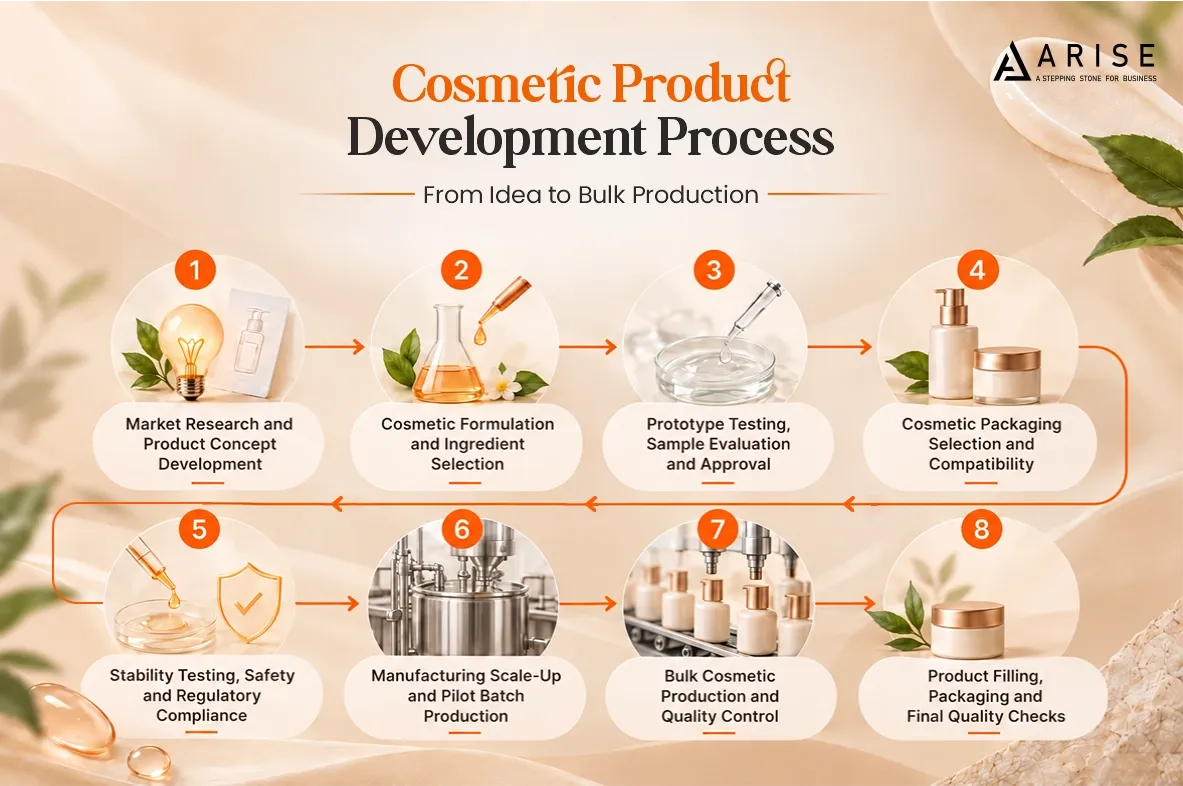
Cosmetic new product development typically follows eight interconnected stages. Although some activities overlap, each stage has important requirements that brands should address before moving forward.
Step 1: Market Research and Product Concept Development
Before developing a formula, brands need to understand what they’re creating and who will use it.
Start by researching your target customers, competing products, ingredient trends, and market demand. Look for opportunities to address specific needs rather than simply introducing another similar product.
Next, prepare a clear product development brief covering:
- Product type and target audience
- Expected benefits and product claims
- Preferred ingredients, texture, and fragrance
- Target price and packaging preferences
- Estimated production quantity
A detailed brief helps formulators understand your expectations and reduces unnecessary changes during development.
Step 2: Cosmetic Formulation and Ingredient Selection
Once the concept is clear, the product moves into formulation development with cosmetic chemists.
They select ingredients based on the product’s intended purpose, performance requirements, and compatibility. Depending on the product, these may include humectants, emollients, surfactants, emulsifiers, preservatives, and active ingredients.
However, selecting the right ingredients is only part of the work.
Formulators must also evaluate ingredient concentrations, pH, viscosity, stability, and interactions between components.
For example, some active ingredients require specific pH conditions or protection from oxidation to remain stable.
The development team then creates an initial laboratory formula for further evaluation.
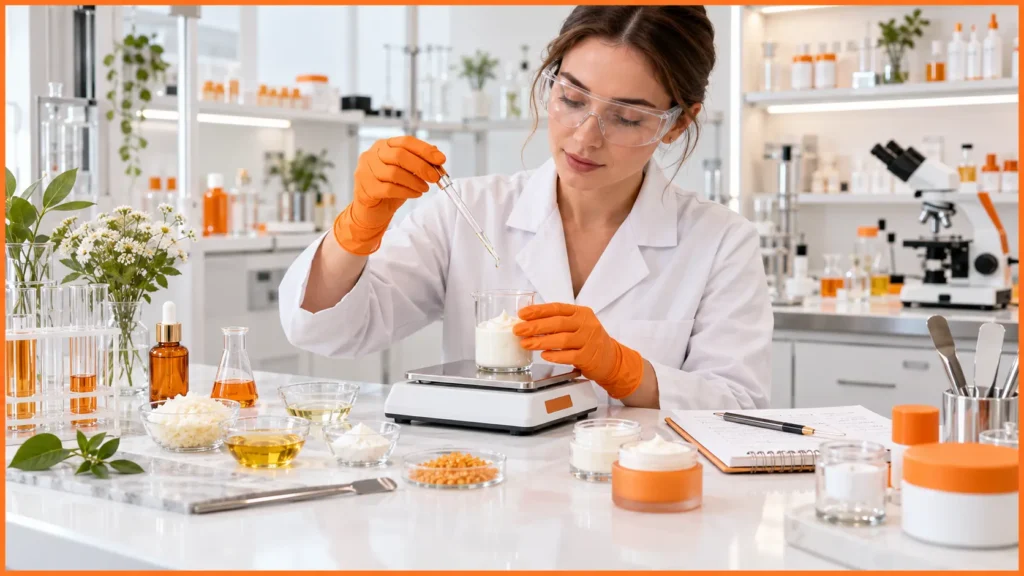
Step 3: Prototype Testing, Sample Evaluation and Approval
The first laboratory sample rarely represents the final product. Brands usually evaluate samples for appearance, texture, fragrance, consistency, absorption, and overall user experience.
For example, a moisturiser might feel too heavy, while a shampoo may need adjustments to its viscosity or foaming performance.
The formulation team uses this feedback to refine the product.
Once the sample meets the agreed requirements, the brand approves a reference sample and its formulation specifications.
This approval provides a benchmark for subsequent testing and manufacturing. It does not replace formal safety or stability testing.
Step 4: Cosmetic Packaging Selection and Compatibility
Packaging does more than make a cosmetic product attractive. It helps protect the formula and determines how consumers use it.
Brands can choose from bottles, jars, tubes, pumps, sachets, and other formats depending on their formulation.
However, packaging compatibility deserves particular attention.
Some formulas may interact with packaging materials, experience colour changes, or lose stability when exposed to light or air. Highly viscous products may also create dispensing problems.
Manufacturers therefore evaluate factors such as:
- Formula and packaging material compatibility
- Protection from light, oxygen, and moisture
- Leakage and dispensing performance
- Filling equipment compatibility
Choosing suitable packaging early helps prevent expensive changes during production.
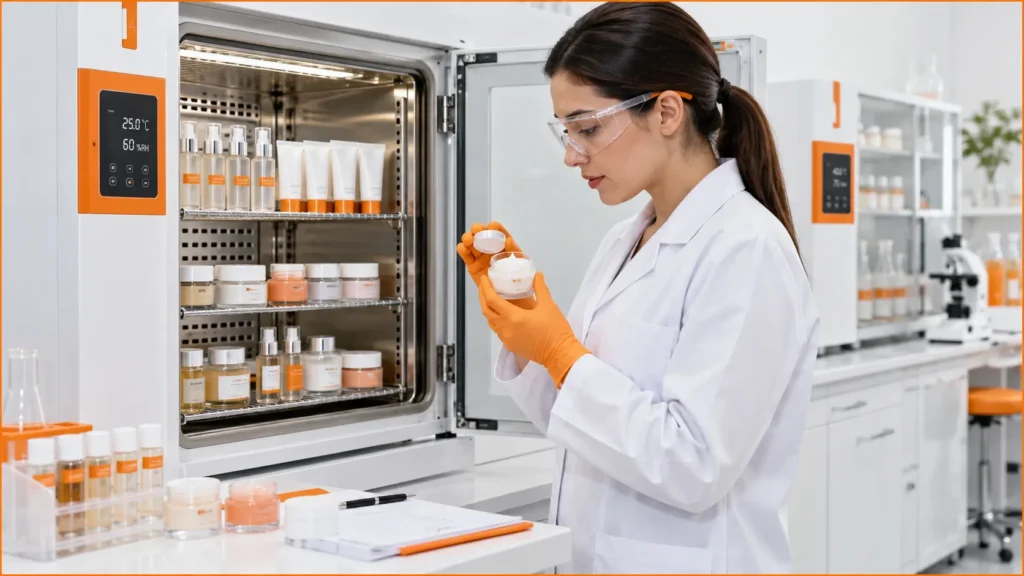
Step 5: Stability Testing, Safety and Regulatory Compliance
Before commercial manufacturing, cosmetic developers need evidence that the product meets its intended quality and safety requirements.
Depending on the formulation, testing may include:
- Stability testing: Evaluates changes in colour, odour, texture, pH, viscosity, and separation under different storage conditions.
- Microbiological testing: Checks for unacceptable microbial contamination.
- Preservative efficacy testing: Evaluates how effectively a preservation system controls microbial contamination when applicable.
- Packaging compatibility testing: Examines interactions between the formula and its container.
Not every cosmetic requires an identical testing programme. Product composition, intended use, packaging, and applicable standards determine the appropriate evaluations.
For cosmetics manufactured in India, manufacturers must hold the appropriate manufacturing licence issued by the State Licensing Authority. Products must also comply with the Cosmetics Rules, 2020, including applicable Bureau of Indian Standards (BIS) specifications, quality and safety requirements, labelling rules, and restrictions on misleading claims.
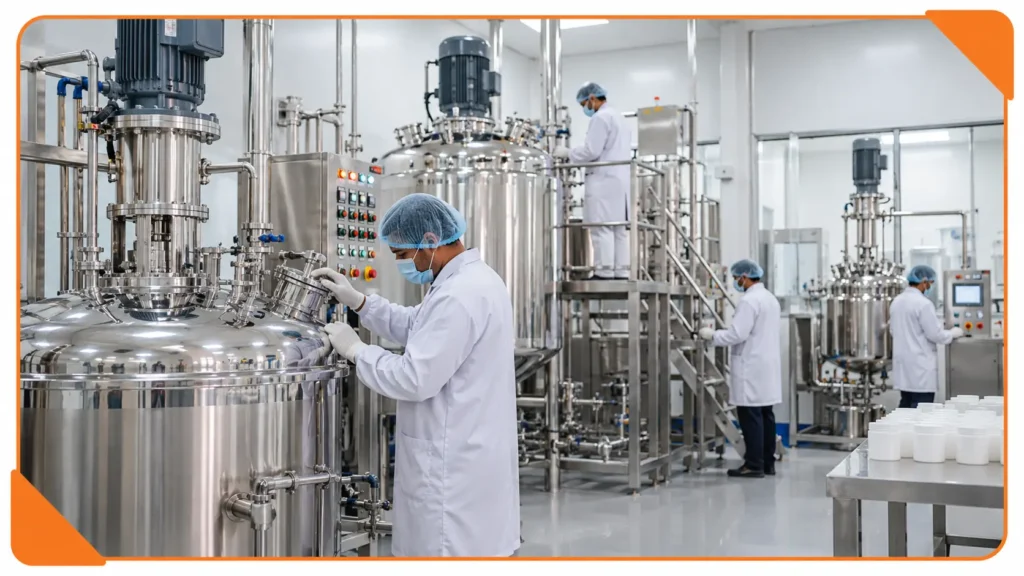
Step 6: Manufacturing Scale-Up and Pilot Batch Production
A successful laboratory formula does not automatically guarantee successful bulk production. When manufacturers increase batch size, mixing conditions, heating and cooling rates, and equipment performance can affect the final product.
For example, a cream that remains smooth in a small laboratory batch may develop a different viscosity when produced in an industrial mixing vessel.
This is where manufacturing scale-up becomes important.
Manufacturers may produce a pilot batch using equipment and processing conditions representative of commercial production. They assess whether the formula maintains its expected consistency, stability, and performance.
This step matters because changes in batch size, mixing time, or heating and cooling rates can shift viscosity, pH, or texture, and a formula tested only at lab scale may behave differently on the shelf.
The team then adjusts and documents manufacturing parameters before proceeding to full-scale production.
Step 7: Bulk Cosmetic Production and Quality Control
Once the formula and manufacturing process receive approval, the manufacturer begins bulk production.
Production typically starts with raw material verification, accurate weighing, equipment preparation, and controlled ingredient addition. Depending on the formulation, the manufacturing process may involve heating, mixing, emulsification, homogenisation, and cooling.
Cosmetic quality control teams monitor relevant parameters, including pH, viscosity, appearance, and batch consistency. Manufacturers also maintain batch records documenting ingredients, processing conditions, and quality checks.
These records support traceability and help identify potential issues if a batch fails to meet specifications.
Step 8: Product Filling, Packaging and Final Quality Checks
After bulk manufacturing, the product moves to filling and packaging.
Manufacturers fill the formula into approved bottles, jars, tubes, or sachets. The packaging line then handles sealing, labelling, batch coding, and secondary packaging.
Before dispatch, quality teams inspect relevant factors such as filling accuracy, packaging integrity, leakage, labelling, and finished-product specifications.
They also review production documentation before authorising batch release.
Once the finished products meet the required standards, they are ready for delivery.

Arise Cosmetic
Arise Cosmetic is a GMP-certified, ISO-compliant, FDCA-approved private label cosmetic manufacturer based in Gandhinagar, Gujarat. Founded in 2017, the team has developed 2,000+ formulations across hair care, skin care, baby care, men's grooming, and intimate hygiene. Arise Cosmetic works with D2C brand founders, salon owners, direct selling companies, and first-time beauty entrepreneurs across Globally, guiding them from formulation brief to bulk delivery under one roof.