
There is no item in your cart
Request a Free Quote
Table of Contents
ToggleTable of Content
Start Your Cosmetic Brand Today!
Introduction
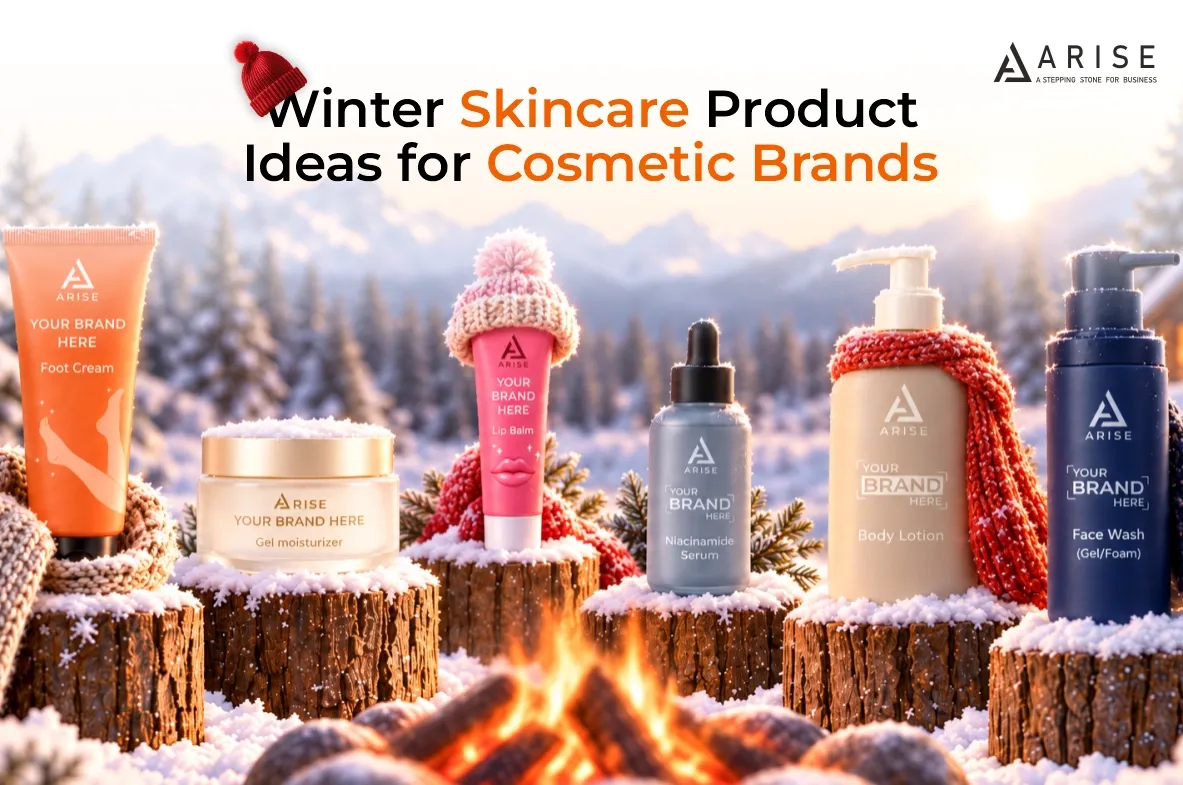
Which winter skincare products should a cosmetic brand add to its line? Six categories see a genuine, recurring shift in demand as temperatures drop: body lotion and body butter, hand cream, foot and heel cream, night cream, hydrating serum, and lip balm.
Each one is private label ready, and several are also available at bulk volume, so a brand does not need to rebuild its catalogue from scratch to capture the season.
Quick Summary
Winter changes what skin needs, not just what marketing says it needs. Cold air, low humidity and indoor heating pull moisture out of skin faster than in warmer months, and that shift shows up consistently across body care, hand and foot care, and facial hydration formats. This guide maps the six categories where the demand is real, what a brand founder should confirm before commissioning each one, and how to decide which to prioritise first when launch time before the season is limited.
Key Takeaways
- Winter demand shifts concentrate in richer, barrier-repairing formats, not in skincare generally.
- The shift is not limited to face care. Body lotion, hand cream and foot cream see it just as strongly.
- Most winter categories are private label ready from low minimum order quantities, with bulk capacity available once a brand scales past its first run.
- Richer, oil-heavier winter formulations usually need their own stability testing pass. A summer formulation’s test data does not automatically carry over.
- Lead time before the season starts is usually the real constraint on a winter launch, not formulation complexity.
- A brand adding its first winter SKU is better served picking one category tied to an existing bestseller than launching a full range at once.
Why Does Winter Create a Product Opportunity for Cosmetic Brands?
Winter creates demand because cold air holds less moisture, and indoor heating dries it out further, so skin loses hydration faster than it does through most of the year. That is a physical change, not a seasonal marketing narrative, and it shows up in what shoppers search for and buy across body care, hand and foot care, and facial hydration formats every year.
For a brand founder, the useful question is not whether this shift exists. It is which part of it is worth building a SKU around, and which part is better left to a competitor. A national skincare brand with broad distribution can justify a six-product winter range. A regional or early-stage brand usually cannot, and forcing a full range out before the season starts is a common way to launch late, under-tested, and thin on shelf presence in every category at once.
Which Winter Skincare Product Categories Should You Consider Adding to Your Line?
The six categories below are where the seasonal shift is strongest and most consistently documented across the market. Each entry covers what changes for winter, how it fits a private label or custom formulation route, and what to check before committing to it.
1. Body Lotion, Body Butter and Rich Body Cream
Body care shows the most visible seasonal shift of any category. Lightweight lotions used through warmer months lose ground to thicker body butters and richer creams built for barrier repair. If a brand already sells a lightweight lotion, a richer winter counterpart is often the fastest line extension to justify, since it can reuse existing packaging and brand positioning while addressing a genuine seasonal gap. Both private label and custom formulation routes are available. Arise Cosmetic’s private label body lotion manufacturing guide covers formulation and MOQ specifics for this category in more depth.
2. Hand Cream
Hands lose surface moisture faster than most other areas of the body in winter, made worse by frequent handwashing and dry indoor air. Hand cream is a compact, low-cost-per-unit category to launch, and it works better as a companion SKU to an existing body or face range than as a standalone launch for a brand with no prior body care presence. Formulation and base selection considerations for this category are covered in more depth in Arise Cosmetic’s hand cream formulation guide.
3. Foot Cream and Cracked Heel Cream
Foot and heel care follows a similar pattern to hand care, with rough, cracked skin becoming a visible seasonal complaint. Few Indian private label brands treat it as a priority launch, which makes it a comparatively open position on shelf and in search for a brand willing to add it ahead of demand rather than after.
4. Night Cream
Night cream sits at the intersection of two demand drivers: the general winter shift toward richer textures, and the existing year-round demand for an overnight, leave-on format. For a brand that already sells a day moisturiser, a winter-weighted night cream is a natural adjacent SKU rather than a new category introduced from scratch.
5. Hydrating Serum
Serums are typically layered ahead of a moisturiser to add hydration before a heavier cream goes on. This is a more formulation-intensive category than the others on this list, and a brand considering it should expect a longer development and stability testing timeline than a body lotion or hand cream extension would need.
6. Lip Balm
Lip balm is one of the lowest-barrier winter categories to add, with compact packaging, low per-unit cost, and strong potential either as a standalone SKU or bundled with a hand or body care launch. It also works well as a first winter product for a brand that has not launched a seasonal SKU before and wants to test the process on a lower-risk category. Arise Cosmetic’s lip balm manufacturer guide covers formulation and supplier options for this category.
Two related categories sit just outside this list but are worth noting. Scalp and hair care see their own winter shift, driven by dryness and flaking rather than moisture loss alone, and that is covered separately in Arise Cosmetic’s anti-dandruff shampoo formulation guide. Baby skin care also sees a winter-specific rise in enquiries, though it should be treated as its own formulation category rather than a scaled-down adult product.
Turn seasonal skincare demand into a focused winter product range for your brand
How Do You Decide Which Winter Categories to Prioritise First?
Pick the category that extends a product you already sell well, rather than opening a new category and a new season at the same time. That single rule resolves most of the prioritisation question on its own.
Beyond that, three factors matter most:
- Catalogue gap: A brand with a body lotion but no hand or foot care has an obvious first move. A brand with a full body care range but nothing in facial hydration should look at night cream or serum instead.
- Lead time remaining: A category needing custom formulation and full stability testing takes longer than one available through an existing private label base. If the season is close, that timeline should decide the category, not the other way round.
- Customer overlap: A winter SKU sells fastest to a brand’s existing customer base. A completely new category, aimed at a customer the brand has not sold to before, is a harder and slower launch regardless of season.
If you are weighing which of these categories fits your current line, Arise Cosmetic’s team can review your existing range and flag the fastest option to market before the season starts.
What Should You Confirm With Your Manufacturer Before Commissioning a Winter Range?
Confirm four things before committing to a winter SKU: production route and volume, lead time, stability testing status, and label compliance. Each affects whether the product is ready before demand peaks, not after.
Production route and volume: Arise Cosmetic manufactures at bulk, wholesale-ready volume for brands scaling an established range, and also supports low minimum order quantities of around 1,000 units per variant for brands testing a new winter category before committing further.
Lead time: Richer, oil-heavier winter formulations generally take longer to develop and test than the lightweight formats a brand may already be running. Confirm a realistic lead time against the season’s start, not the manufacturer’s fastest-case estimate.
Stability testing: A richer winter formulation is a different product from its summer counterpart, not a variant of it, and it needs its own stability testing pass. Existing test data on a related product does not automatically transfer.
Label and claims compliance: Cosmetic products manufactured and sold in India fall under the Cosmetics Rules, 2020, administered by the Central Drugs Standard Control Organisation. Any claim on packaging or marketing material should be checked against what the formulation and test data can actually support before it goes to print.
Build your winter SKU with the right formulation, testing, packaging, and production support.
Building Your Winter Range
Winter does not require a brand to relaunch itself. It requires a brand to identify which one or two categories genuinely shift with the season, confirm production route, lead time and testing status early, and commission accordingly. Arise Cosmetic supports both private label and custom formulation across all six categories above, at bulk volume for established ranges and low minimum order quantities for brands testing a new category, under GMP, ISO 22716 and FDCA compliance.
Ready to plan your winter range? Get in touch with Arise Cosmetic to review your current catalogue and confirm the fastest route to market before the season starts.
FAQs
Q1. Do winter skincare product ideas differ by region in India?
Yes. Demand for richer, heavier formats is strongest in regions with a sharper winter, largely north India, while brands selling primarily in southern or coastal markets may see a smaller shift concentrated in hand, foot and lip care rather than a full body care range.
Q2. Can I add a winter SKU to my existing line without a full private label setup?
Yes, if the category is already available through a private label catalogue. Adding a winter variant of a category you already stock, such as a richer body cream alongside an existing lotion, is faster than commissioning a category you have never sold before.
Q3. What is a reasonable lead time to launch a winter range before the season starts?
It depends on the category and route. A private label extension of an existing category can move faster than a custom formulation, which needs its own development and stability testing cycle. Confirm a specific timeline with your manufacturer against your target launch date, rather than assuming a standard figure applies across categories.
Q4. Is custom formulation necessary for winter products, or can ready formulations work?
Not necessarily. A brand extending an existing category, such as a richer version of a lotion it already sells, is often better served by a private label base. Custom formulation makes more sense for a brand building a distinct winter identity or entering a category it does not currently stock.
About the Author

Arise Cosmetic
Arise Cosmetic is a GMP-certified, ISO-compliant, FDCA-approved private label cosmetic manufacturer based in Gandhinagar, Gujarat. Founded in 2017, the team has developed 2,000+ formulations across hair care, skin care, baby care, men's grooming, and intimate hygiene. Arise Cosmetic works with D2C brand founders, salon owners, direct selling companies, and first-time beauty entrepreneurs across Globally, guiding them from formulation brief to bulk delivery under one roof.