
There is no item in your cart
Request a Free Quote
Table of Contents
ToggleTable of Content
Start Your Cosmetic Brand Today!
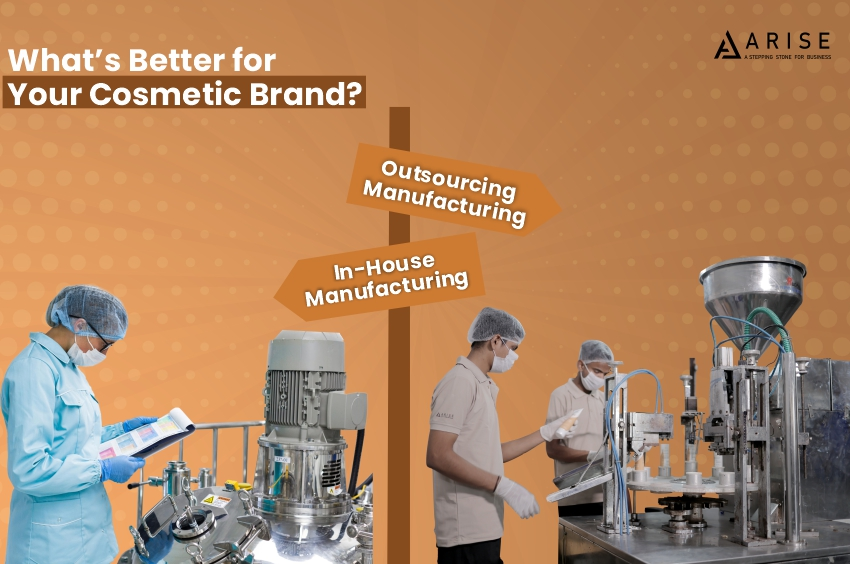
Introduction
When you’re launching a cosmetic brand, one decision will define your entire operation: should you build your own manufacturing unit or outsource production to a specialist? This is not a question with a one-size-fits-all answer.
The choice between in-house manufacturing and outsourcing depends on your budget, timeline, team capability, and long-term vision. What we’ve seen is that most successful startups and scaling brands choose outsourcing cosmetics manufacturing, while established companies with significant capital invest in in-house facilities. Now the question is not which is “better,” but which is right for where you are today.
This blog helps founders, brand owners, and distributors understand which manufacturing route supports sustainable growth in the Indian cosmetics market.
Key Takeaways
- In-house manufacturing is a scale optimisation decision, not a launch strategy.
- Outsourcing cosmetics manufacturing lowers capital and compliance risk.
- Speed to market is significantly higher with outsourcing.
- Quality depends on process maturity, not facility ownership.
- Most Indian cosmetic brands scale faster with private label partners.
Who is This Blog For?
This blog is for you if you’re :
- An emerging cosmetic brand founder deciding between in-house vs outsourcing cosmetic manufacturing.
- An established brand looking to scale production without massive capital expenditure.
- Someone with limited chemistry expertise wants professional guidance.
- D2C brand testing products before committing to a large inventory.
If you are already manufacturing and wondering whether to bring more in-house, this will also help clarify that decision.
In‑House Manufacturing: What is it?
In-house manufacturing means you own the facility, equipment, raw materials, and the entire production process. You’re responsible for everything – formulation, quality control, packaging, and compliance.
In cosmetics, in-house manufacturing involves:
- Setting up a licensed manufacturing unit
- Purchasing formulation, filling, and packaging machinery
- Managing raw material sourcing
- Handling CDSCO, GMP, and safety compliance internally
This model offers control but introduces fixed operational costs and regulatory responsibility from day one.
Outsourcing Manufacturing: What is it?
Outsourcing cosmetics manufacturing means partnering with a third-party manufacturer who handles production on your behalf, under your brand name.
Outsourcing typically includes:
- Access to ready formulations or custom development
- Manufacturing under audited GMP facilities.
- Regulatory and quality assurance are handled by the manufacturer
- Flexible MOQs
If you want to start your own cosmetic brand, this model allows you to focus on branding, distribution, and sales, not plant management.
Key Differences Between In‑House and Outsourcing Manufacturing for Cosmetics
When evaluating in-house manufacturing vs outsourcing, these practical differences matter most:
| Factor | In-house Manufacturing | Outsourcing Cosmetic Manufacturing |
|---|---|---|
| Initial capital required | ₹50 lakhs – ₹2+ crores | ₹10-15 lakhs (excluding product launch costs) Of course, the number may change according to the requirements. |
| Launch product time | 6-12 months (facility setup + formulation) | 2-4 months (formulation + sampling) |
| Production flexibility | High (you control pace) | Instead of being limited by fixed capacity, production can be aligned according to demand and requirements as the brand grows |
| Formula confidentiality | Complete (formula stays with you) | Shared with manufacturer (though NDAs protect it) |
| Quality control | You own it 100% | Shared responsibility; manufacturer’s QC is essential |
| Scalability | Limited by your facility capacity | Flexible; scale up/down based on demand |
| Compliance & regulations | Your responsibility entirely | Manufacturer shares responsibility; you remain liable |
| Cost per unit | Lower (spreads fixed costs) | Starts higher with initial MOQ; drops significantly with bulk orders. |
| Product customisation | Expensive and slow to iterate | Easy and fast; iterate quickly before committing to the final formula |
| Team requirements | Chemist, QA/QC staff, operators, managers | Minimal internal team required; brand can focus on branding/marketing etc |
This comparison of in-house vs outsourcing cosmetic manufacturing shows the reality, where the choice is not about which model is objectively superior. It’s about where your resources, expertise, and timeline match well.
When Does In‑House Manufacturing Make Sense?
In-house manufacturing becomes the right choice when certain conditions align.
1. You have significant capital (₹75+ lakhs minimum, ideally ₹1.5+ crores)
A manufacturing facility becomes a liability during slow sales periods. Utility bills, maintenance, and staff salaries don’t pause when revenue does.
2. You’ve proven consistent demand
If you are doing ₹3-5 crores annually in revenue and demand is predictable, in-house manufacturing works. Fixed costs become manageable when volume justifies them.
3. Your formula is proprietary and highly valuable
If your competitive advantage depends on a unique formulation (think of a brand with a patented active ingredient or a signature texture), keeping production in-house protects that IP. Fewer people know your secret process.
4. You have or can hire cosmetic chemistry expertise
This is critical and often overlooked. You need someone who understands not just chemistry, but cosmetic challenges, stability, microbial safety, texture appeal, and shelf-life. A general chemist is not enough.
5. You’re in a high-demand stable category
Brands making volume products like shampoos or soaps in large batches see better economics in-house. Brands making niche products or frequently changing formulations don’t.
6. You’re preparing for scale beyond ₹10 crores in revenue
Large, established brands often bring production in-house because per-unit costs become significantly lower at massive volume.
Why Outsource Manufacturing is Best for Your Cosmetic Brand?
For most Indian cosmetic brands, especially those starting or scaling aggressively, outsourcing cosmetics manufacturing is the strategic & superior choice.
The benefits of choosing a private label cosmetics manufacturer are substantial and often underestimated.
1. Speed to market is everything
In beauty, trends change fast. Brands that can launch new products within 2-3 months have a massive advantage.
Outsourcing partners with existing R&D capabilities can get you from concept to sampling in 4-6 weeks.
In-house, even with resources, this takes 3-4 months, and that’s if everything goes smoothly. In a market where first-mover advantage matters, this speed is worth the per-unit premium.
2. Capital efficiency changes your growth direction
Consider two founders with ₹50 lakhs each.
Founder A invests ₹40 lakhs into a manufacturing facility and ₹10 lakhs into the initial product launch.
Founder B invests ₹10 lakhs into the first product batch with an outsourcing partner and ₹40 lakhs into marketing and market expansion.
After 18 months, Founder B has tested 4-5 product variants, built brand presence across 3 cities, and generated ₹1.5+ crores in revenue.
Founder A is still fixing equipment and cash-flowing operations. Founder B now has ₹50+ lakhs to invest in an in-house facility if needed. Capital allocation matters more than capital size.
3. Risk distribution protects your brand
When you outsource cosmetics manufacturing, the manufacturer takes up significant operational risk. They own equipment maintenance. They manage staff. They handle regulatory audits for manufacturing practices.
You’re just adding the parameters of quality and safety, and not removing responsibility.
Your brand is still liable for product safety, but the manufacturer’s QA/QC processes are built to catch issues before they reach consumers.
4. Get the best quality & the right partner
This is the biggest myth about outsourcing. A reputable cosmetic manufacturer operates under GMP (Good Manufacturing Practice), ISO 22716 (Cosmetics Manufacturing Standards), and Indian Drugs and Cosmetics Act compliance.
Their labs conduct stability testing, microbial testing, and quality checks at every batch. Many startups manufacturing in-house skip these steps due to cost pressure, and outsourcing partners can’t, as their reputation depends on it.
Outsourced products have less (very few) defect rates than in-house products when the manufacturer is certified and experienced.
5. Customisation is fully available
You can develop custom formulations specific to your brand. Want a sulfate-free, silicone-free hair shampoo with hibiscus extract?. The manufacturer’s R&D team formulates it, tests it, and manufactures it under your label. You own the exclusivity of that formula. You’re not using a generic product.
6. Scalability without infrastructure issues
Demand for your brand jumps 50%? Outsourcing partners adjust production.
Your facility can’t suddenly run 24/7 without hiring, training, and managing new staff. Outsourcing means you scale more units per batch, faster turnarounds. When demand softens, you reduce orders without holding overhead costs.
This flexibility is worth thousands of rupees monthly in avoided costs.
7. You focus on what actually builds brands
You become an expert at marketing, understanding customer needs, creating brand identity, and distribution strategy.
You’re not managing maintenance schedules, training production staff, or troubleshooting equipment. Brands that outsource often report spending 3-4x more on customer acquisition and market research than those managing in-house production, and it shows in brand strength and market presence.
Outsource Your Cosmetics Production to Arise Cosmetic
If you look closely at how modern cosmetic brands scale, one pattern is consistent: they do not try to own everything.
Mamaearth, Derma co., Lakme, and Nykaa are the legacy brands that have shown that community, speed, and operational flexibility matter more than owning the factory floor.
Arise Cosmetic supports brands that want to build long-term presence without short-term strain. Our intent is not just to manufacture products, but to enable brands to move with the market, not behind it.
Get in touch with our experts today and let us build your brand the smart way!
Looking to Start Your Own Cosmetic Brand?
FAQS
Q1. Should I choose in-house or outsourcing for my cosmetic brand’s manufacturing?
Outsourcing is better for launch and scale. In-house suits established brands with stable volumes.
Q2. Which is more cost-effective, in-house or outsourcing cosmetics production?
Outsourcing is more cost-effective in the first 3–5 years for most cosmetic brands in India.
Q3. Which option provides higher-quality products?
Quality depends on systems, not ownership. Established private label manufacturers often deliver better consistency.
About the Author

Arise Cosmetic
Arise Cosmetic is a leading private label cosmetic manufacturer. We manufacture a wide range of products across categories like haircare, skincare, baby care, intimate hygiene, and men’s grooming. From startups to established beauty houses, we proudly cater to businesses of all sizes across India. Our aim is to become India’s most trusted cosmetic manufacturer and compete proudly with global leaders.
1.What is a private label in cosmetics?
A private label in cosmetics means a third-party manufacturer produces products sold under another brand’s name, letting businesses offer their own cosmetic lines without needing their own factories.
2. Can I launch a cosmetic brand without manufacturing?
Yes, you can launch a cosmetic brand without manufacturing by using private label services. This lets you focus on branding and sales while a third party handles production.
3. How long does it take to launch a private label cosmetic line?
Launching a private label cosmetic line typically takes 3 to 9 months, depending on product complexity, customisation, and regulatory approvals.
4. What’s the minimum order quantity for private label cosmetics?
The minimum order quantity (MOQ) for private label cosmetics is typically 1000 units per variant, though this can vary by manufacturer and product.