
There is no item in your cart
Request a Free Quote
Table of Contents
ToggleTable of Content
Start Your Cosmetic Brand Today!
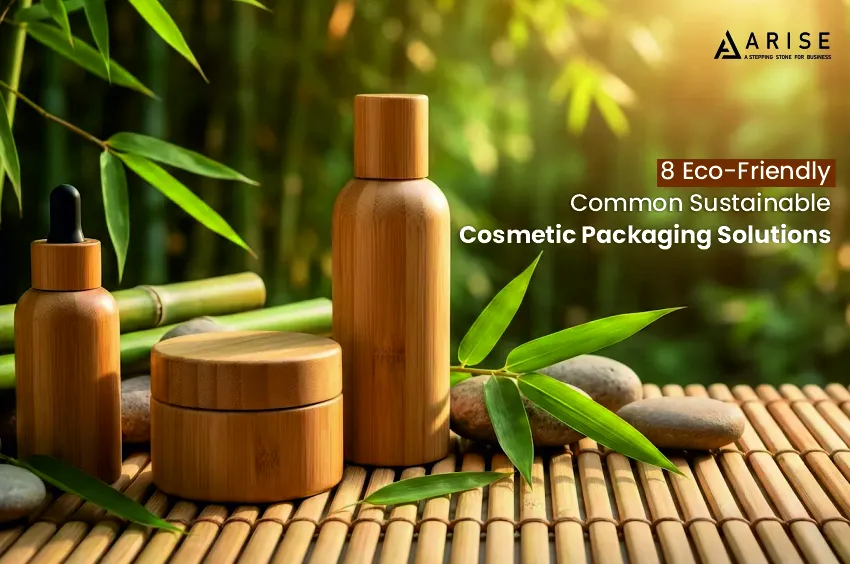
Introduction
Think sustainable packaging is expensive and complicated? It’s actually the smart way to save money and keep customers.
Sustainable cosmetic packaging solutions help you reduce waste, meet government rules, and build a brand people love.
This blog highlights 8 proven sustainable packaging alternatives, detailing what leading Indian brands are using, why it works for them and how you can implement it, too!
Recommended Read – Sustainable Cosmetic Packaging: Meaning, Importance, Benefits
Key-Takeaways
- Start with a simple packaging audit; you don’t need to change everything at once.
- In India, ‘biodegradable’ plastic often doesn’t break down. Choose glass or aluminium instead, which get recycled.
- Use one type of material for your whole package. It makes recycling easy and effective.
- Refills work best for brands with loyal, repeat customers who buy your product again and again.
- Sustainable packaging helps you follow new government rules and makes customers trust your brand more.
- Your package is only truly sustainable if the local kabadiwala can and will recycle it.
- Pick the eco-friendly option that actually works for your product and for India’s recycling system.
8 Eco-Friendly Common Sustainable Cosmetic Packaging Solutions
1. Post-Consumer Recycled (PCR) Plastics
PCR plastics are packaging materials manufactured from recycled plastic collected from consumer waste streams, typically sourced from recycled bottles, containers, and other post-consumer products that have completed their lifecycle.
PCR packaging reduces energy consumption by 79% and greenhouse gas emissions by 67% compared to virgin plastic manufacturing.
Best for: Bottles, jars, tubes, pump dispensers, and closures across skincare, haircare, and personal care categories. Particularly effective for brands marketing to environmentally conscious consumers in tier 1 and tier 2 cities, where sustainability awareness is highest!
2. Glass Packaging
Glass packaging has been used in cosmetics since the industry’s inception. What makes it sustainable is its infinite recyclability without quality degradation.
From a brand positioning perspective, glass signals premium quality. The weight, clarity, and aesthetic appeal of glass packaging create an unboxing experience that justifies higher price points essential for brands competing in the luxury or professional cosmetic segments.
Best for: Serums, facial oils, concentrated treatment products, luxury fragrances, and salon-professional products.
3. Aluminium Containers and Tubes
Aluminium packaging includes tubes for creams and gels, jars for balms and pomades, and bottles for liquid products. Aluminium is infinitely recyclable whilst being lightweight, addressing both sustainability and logistics concerns.
For brands, aluminium offers design flexibility. It accepts various printing techniques, embossing, and finishing treatments that create a distinctive shelf presence. The premium experience positions products in the higher-value segment whilst delivering genuine environmental benefits.
Best for: Creams, balms, gels, and products with unstable active ingredients. Ideal for travel-sized products, men’s grooming lines, and natural/organic formulations requiring extended shelf life without heavy preservative systems.
Looking for sustainable cosmetic packaging solutions?
4. Biodegradable and Plant-Based Plastics
Plant-based plastics are derived from renewable sources, including cornstarch, sugarcane, algae, and other plant materials. These bioplastics are designed to break down under specific conditions, reducing long-term environmental persistence compared to petroleum-based plastics.
Best for: Brands with strong environmental positioning targeting highly conscious consumers in tier 1 cities. Most effective for dry products (powders, pressed compacts) where barrier property limitations are less critical.
5. Refillable and Reusable Systems
Refillable packaging involves durable primary containers designed for multiple uses, with consumers purchasing refill pouches or cartridges to replenish products. This system eliminates repeated production and disposal of primary packaging, focusing material use on lightweight refill formats.
While brands like SkinKraft and Plum have successfully introduced refill cartridges, proving the model’s viability, the Indian refill revolution remains a premium play. For mass-market brands, the hurdle is not innovation, but scaling the consumer behaviour shift and solving last-mile logistics for refill distribution.
Best for: Premium skincare and haircare products with high customer loyalty and repeat purchase rates. Most successful in controlled distribution channels (brand-owned retail, salons, clinics) where education and engagement can drive adoption. Works exceptionally well for products with visible consumption (face creams, body lotions) where customers can predict when refills are needed.
6. Paper-Based and Cardboard Solutions
Paper-based packaging includes cardboard tubes, paperboard boxes, moulded pulp containers, and paper-wrapped bars for solid products. These solutions replace plastic packaging with renewable, biodegradable materials derived from wood fibres.
Best for: Secondary packaging (outer boxes, shippers), solid products (shampoo bars, soap bars, solid perfumes), powder formulations (loose powders, bath salts), and pressed compacts where minimal moisture exposure is expected.
7. Minimalist and Lightweight Design
Minimalist packaging and lightweighting involve reducing total material use through design optimisation, thinner walls, smaller dimensions, elimination of unnecessary components, and streamlined structures that use 20-40% less material whilst maintaining functional performance.
Minimalist packaging design is gaining popularity in India’s clean beauty segment, where simplicity signals transparency and ingredient focus rather than marketing manipulation. Brands targeting millennials and Gen Z consumers find that minimal design resonates with values of authenticity and environmental consciousness.
Best for: All product categories benefit from thoughtful lightweighting. Most impactful for high-volume products where small per-unit reductions create significant aggregate material savings. Particularly valuable for brands with national distribution, where transport efficiencies multiply across extensive logistics networks.
8. Mono-Material Packaging
Mono-material packaging uses a single material type throughout the entire package, enabling complete recyclability by eliminating the need to separate different materials before recycling. Traditional packaging often combines plastics, metals, paper, and adhesives, making recycling difficult or impossible.
Best for : All packaging types benefit from mono-material design, particularly pumps, sprayers, and closures that typically combine materials. Most valuable for brands making verifiable recycling claims and operating in markets with Extended Producer Responsibility (EPR) regulations that penalise non-recyclable packaging.
Need help choosing the right sustainable packaging solution for your cosmetic products?
Contribute to This Planet by Choosing Sustainable Cosmetic Packaging Solutions
Here’s how to approach this decision practically:
1. Start with a material compatibility assessment
Your formulation determines which packaging materials are technically viable.
2. Evaluate supply chain readiness
Can your current filling lines handle the new material? What’s the local availability of sustainable materials? Do you have reliable suppliers with consistent quality and capacity? The technically superior solution that requires importing materials with 90-day lead times may create more operational problems than the locally available alternative with slightly lower environmental credentials.
3. Calculate true lifecycle cost, not just material cost
This includes tooling modifications, inventory carrying costs for new SKUs (if implementing refills), transport cost changes, and potential pricing premium your market will support.
4. Match sustainability claims to infrastructure reality
Compostable packaging only delivers environmental benefits if composting infrastructure exists in your distribution markets.
5. Implement incrementally rather than comprehensively
Test sustainable alternatives on limited SKUs or specific markets before full conversion.
6. Prioritise transparency over perfection
Customers respect honest communication about sustainability efforts and limitations more than greenwashed perfection claims.
Final Words
Your packaging decisions today determine your market access, regulatory compliance, and competitive position tomorrow.
This is precisely why partnering with an experienced private label manufacturer who has already been through these matters. At Arise Cosmetic, we’ve formulated products and developed packaging across sustainable materials – PCR plastics, glass, aluminium, paper-based solutions, and refillable systems for brands at every price point and market position. We conduct material compatibility testing, validate barrier properties, and ensure your packaging protects your formulation whilst delivering on sustainability commitments.
Get in touch with our team of experts to discuss your formulation and discover which sustainable materials will deliver the protection and shelf life your products deserve.
FAQs
Q1. What are the most eco-friendly packaging options for cosmetics?
Refillable systems top the list, followed by infinitely recyclable materials like glass and aluminium, then certified compostables. The best choice depends on your product type and India’s recycling system.
Q2. How can I make my cosmetic packaging more sustainable?
Start practically, switch to PCR content, eliminate unnecessary plastic layers, and design for mono-material. Even small, scalable changes significantly reduce your environmental footprint without a full overhaul.
Q3. How do eco-friendly packaging solutions help the beauty industry?
They directly tackle the industry’s waste problem, build consumer trust in an era of greenwashing, and future-proof brands against tightening regulations like India’s EPR framework.
About the Author

Arise Cosmetic
Arise Cosmetic is a GMP-certified, ISO-compliant, FDCA-approved private label cosmetic manufacturer based in Gandhinagar, Gujarat. Founded in 2017, the team has developed 2,000+ formulations across hair care, skin care, baby care, men's grooming, and intimate hygiene. Arise Cosmetic works with D2C brand founders, salon owners, direct selling companies, and first-time beauty entrepreneurs across Globally, guiding them from formulation brief to bulk delivery under one roof.
1.What is a private label in cosmetics?
A private label in cosmetics means a third-party manufacturer produces products sold under another brand’s name, letting businesses offer their own cosmetic lines without needing their own factories.
2. Can I launch a cosmetic brand without manufacturing?
Yes, you can launch a cosmetic brand without manufacturing by using private label services. This lets you focus on branding and sales while a third party handles production.
3. How long does it take to launch a private label cosmetic line?
Launching a private label cosmetic line typically takes 3 to 9 months, depending on product complexity, customisation, and regulatory approvals.
4. What’s the minimum order quantity for private label cosmetics?
The minimum order quantity (MOQ) for private label cosmetics is typically 1000 units per variant, though this can vary by manufacturer and product.